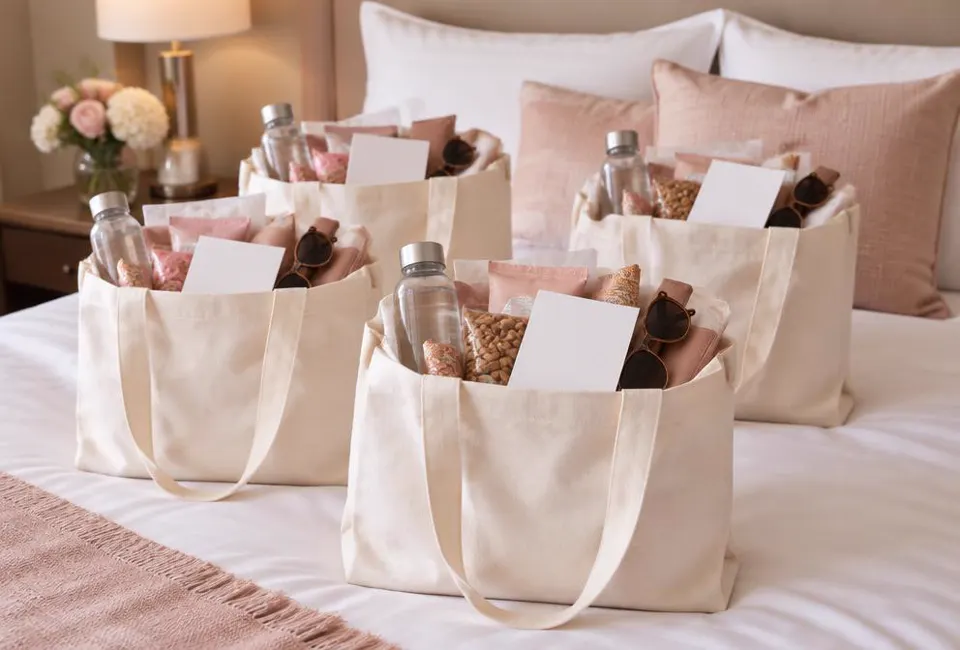
Establishing Your Welcome Bag Budget
Crafting a destination wedding welcome bag guide starts with a rigorous financial plan to ensure your hospitality does not compromise your total event solvency. By aligning your gifting expectations with realistic regional benchmarks, you can create a memorable first impression for traveling guests.
When planning your destination wedding welcome bag guide, the industry standard suggests allocating five percent of your total wedding budget toward guest gifting and favors. This figure covers the bag itself, the contents, and any associated delivery fees charged by the hotel. For a couple in Australia with a budget of A$35,315 (Easy Weddings 2025), this equates to roughly A$1,765 for gifts. In Canada, where the average cost is C$30,000 (RBC), you should aim for C$1,500. Sticking to this percentage ensures that your generosity scales naturally with the overall luxury level of your celebration without causing late stage financial strain.
Implementing a Tiered Allocation System
To balance quality against quantity, use a tiered system based on room occupancy rather than individual headcounts. For example, Sarah and David are hosting a wedding in Italy. Instead of buying sixty small bottles of olive oil for every guest, they provide one high quality bottle per hotel room. This approach allows them to spend more on premium, locally sourced items that guests will actually value. By calculating costs per room, you reduce the number of vessels needed and can afford durable, reusable bags that survive the journey home, rather than flimsy single use options.
| Expense Category | Local Sourcing Model | Imported Goods Model |
|---|---|---|
| Shipping and Freight | Zero to minimal delivery fees | High international shipping rates |
| Customs and Duties | Non-applicable | 15 to 30 percent of item value |
| Risk of Damage | Low: handled by local vendor | High: breakage during transit |
| Guest Experience | Authentic regional discovery | Familiar but generic items |
Importing goods for your welcome bags often incurs hidden costs that can double your initial price per item. In the UK, where wedding costs range from £20,600 (Bridebook 2024) to £23,000 (Which? 2024), couples often find that customs duties on imported snacks or branded merchandise eat into their floral or catering funds. Choosing locally produced items eliminates the risk of items being held at the border. Furthermore, sourcing locally supports the community hosting your event. In a US context with an average budget of $33,000 (The Knot Real Weddings Study 2025), a local strategy keeps $1,650 circulating within the destination economy.
Finalizing your budget requires a firm decision on the vessel. A common mistake is selecting a bag that is too large, which creates a psychological need to fill it with filler items that add no value. Choose a size that feels full with three to five high quality items. If your budget is tight, prioritize a functional map and one local snack over a bag filled with cheap plastic trinkets. This ensures that every dollar spent contributes to the comfort and navigation of your guests in an unfamiliar location, fulfilling the primary purpose of the welcome gesture.
Budgeting Action Items
- Calculate 5 percent of your total wedding budget as the absolute ceiling.
- Divide the total gift budget by the number of hotel rooms booked.
- Request a written quote for room delivery fees from your hotel coordinator.
- Compare the price of a local snack versus an imported alternative including shipping.
- Set aside a 10 percent buffer for last minute additions or extra guests.
- Verify if local taxes are included in the shelf price of your chosen items.
- Confirm if the hotel provides complimentary bottled water to save on drink costs.
- Determine if you will use a single bag per couple or per individual guest.
The Five Essential Categories of Contents
Developing a destination wedding welcome bag guide requires a structured approach to ensure guests feel cared for the moment they arrive. By organizing contents into five core categories, couples can create a cohesive experience that addresses physical needs and local culture.
The foundation of a successful welcome bag is hydration and health. Guests often arrive dehydrated from long flights or climate changes. Instead of basic water, consider the environment. For a tropical beach wedding, electrolyte powder packets are essential to combat humidity and heat exhaustion. If the celebration is in a high altitude alpine setting, include oxygen canisters or specialized hydration tablets to mitigate altitude sickness. This category serves as the first line of defense for guest comfort, ensuring everyone remains energized for the upcoming festivities without needing to find a local pharmacy immediately upon arrival.
Applying the Selection Framework: Sarah and Mateo
Consider the scenario of Sarah and Mateo, who are hosting their wedding in a remote village in the Italian countryside. To select their contents, they evaluated the specific challenges of their location. Since the cobblestone streets are difficult for walking, they included cushioned blister pads in the comfort category. For local flavors, they sourced small bottles of olive oil from the estate where they are staying. By focusing on items that solve a problem or tell a story about the region, Sarah and Mateo ensured their bags were functional rather than just decorative, providing value that lasted the entire weekend.
| Category | Tropical / Coastal | Alpine / Winter | Urban / City |
|---|---|---|---|
| Hydration | Electrolyte powder | Herbal tea bags | Sparkling water |
| Local Flavors | Dried mango or pineapple | Maple sugar or chocolate | Artisan sourdough crisps |
| Comfort Items | Cooling face mist | Disposable hand warmers | Folding paper fan |
| Navigation | Waterproof map | Ski trail guide | Transit pass or card |
| Personal Note | Message on cardstock | Vellum paper insert | Recycled paper note |
Local flavors provide the first cultural immersion for your guests. These items should be easy to consume and representative of the region. Think of artisanal snacks, local coffee blends, or honey sourced from nearby farms. Avoid items that are overly fragile or liquid based if guests have to fly home with them. Instead, focus on small, shelf stable goods that offer a literal taste of the destination. This category builds excitement and allows guests to sample the best of the local pantry before the official catering begins at the rehearsal dinner or welcome party.
Comfort and navigation items bridge the gap between a hotel room and the wedding venue. Comfort items might include sunscreen, insect repellent, or stain remover pens. Navigation involves more than just a map. It should include a detailed itinerary with addresses, transportation contact numbers, and dress code reminders for each event. While digital maps are common, a physical printout is a reliable backup for areas with poor cellular service. Providing these tools gives guests autonomy, reducing the number of logistical questions directed at the couple during the high pressure hours before the ceremony.
Essential Category Checklist
- Two bottles of water or hydrating fluids per guest
- One salty and one sweet local snack per bag
- Climate specific comfort item like lip balm or fans
- Physical itinerary with start times and locations
- Contact information for the wedding coordinator
- Personalized note welcoming the guest by name
- Safety items like bandages or pain relief packets
- Transportation instructions for all weekend events
The final and most important category is the personal note. This is where you express genuine gratitude for the time and expense guests have invested to travel. A handwritten note or a high quality printed card with a signature makes the bag feel like a gift rather than a generic kit. Use this space to share a brief story about why you chose the location or a list of your favorite local spots. This personal touch transforms the collection of items into a warm welcome that sets the emotional tone for the entire destination wedding experience.
Shipping Versus Sourcing Locally
Strategizing how your destination wedding welcome bag guide materials reach your guests is a critical logistical hurdle that impacts both your budget and your stress levels. You must weigh the convenience of domestic sourcing against the unpredictable complexities of international logistics and customs regulations.
The Hidden Costs of International Shipping
While shipping pre-assembled bags from home might seem organized, couples often overlook the financial weight of duties and taxes. Customs officials frequently apply high tariffs to bulk shipments of textiles or pre-packaged foods. For example, a couple in Australia might face costs exceeding their original budget if they ship heavy items, considering the average Australian wedding costs A$35,315 according to Easy Weddings 2025. Beyond the carrier fees, you risk the 'holding fee' if items are delayed at a border, which can double your shipping expenses overnight. Additionally, you must factor in the insurance costs for fragile items like glass jars or liquid contents.
Consider the scenario of Leo and Maya, who shipped fifty welcome bags from Canada to Italy. Even with Canada's average wedding cost at C$30,000 per RBC data, they spent nearly ten percent of their total gift budget just on courier surcharges and unexpected brokerage fees. Because the bags contained branded bottled water, the weight drove the price up exponentially. Many couples find that the convenience of having everything ready at home is negated when they have to spend their first afternoon abroad at a customs warehouse instead of a rehearsal dinner. It is often more efficient to ship only lightweight, flat items like custom stationery.
| Scenario | Sourcing Strategy | Key Benefit | Risk Level |
|---|---|---|---|
| Branded Paper Goods | Ship from Home | Quality Control | Low |
| Heavy Liquids or Snacks | Buy Locally | Weight Savings | Medium |
| Fragile Glassware | Buy Locally | Zero Breakage | Low |
| Personalized Textiles | Ship from Home | Custom Branding | Medium |
| Alcoholic Beverages | Buy Locally | Legal Compliance | High if Shipped |
Buying in the host country allows you to capitalize on regional specialties that guests will appreciate more than generic items. Local sourcing also avoids the environmental impact of long distance air freight. You can hire a local planner to procure these items or schedule a dedicated shopping day upon arrival. This approach ensures that perishable items like local pastries or fruit are fresh. By sourcing locally, you also bypass the risk of your entire shipment being lost or damaged in transit, which could leave you with no gifts for your guests after months of planning and expense.
Shipping and Sourcing Readiness Checklist
- Verify if your hotel accepts packages at least two weeks before the event.
- Check local import laws for specific items like seeds or honey.
- Calculate the total weight of one bag to estimate bulk shipping costs.
- Identify the nearest supermarket or market to your venue for emergency supplies.
- Confirm if the hotel charges a per-bag storage or delivery fee.
- Print customs forms accurately to avoid luxury tax misclassification.
- Set aside a budget for local taxi or courier transport for shopping trips.
- Check if your shipping provider offers door to door tracking.
- Request a photo from the hotel staff once the packages arrive safely.
Negotiating Storage and Distribution with Hotel Management
Hotels often charge for the labor involved in storing and distributing bags to guest rooms. These fees can range from five to fifteen dollars per bag. It is essential to get these costs in writing before you arrive. Use the following script to initiate this conversation: Dear [Manager Name], we are looking forward to our stay. We plan to provide welcome bags for our guests. Could you please clarify your policy regarding receiving shipments, the daily storage fee per box, and the specific cost for room delivery versus handing them out at the front desk? We want to ensure a smooth arrival experience for everyone involved.
Managing these logistics effectively requires clear communication. If the hotel fees are prohibitive, consider handing the bags out during a welcome cocktail hour instead of having them delivered to rooms. This can save you hundreds of dollars that could be better spent on the contents of the bags themselves. Always confirm the name of the person who will be receiving the goods and ask for a specific storage location that is climate controlled. Heat and humidity in tropical destinations can ruin chocolates or melt wax seals if the bags are left in a non-air-conditioned loading dock for several days.
Choosing the Right Vessel for Travel
The vessel you select serves as the primary transport mechanism for your gifts and a lasting memento of your celebration. This decision impacts your shipping logistics, the guests' luggage space, and the environmental footprint of your event.
When selecting a vessel for your destination wedding welcome bag guide, prioritize the journey home. Most guests travel with limited luggage capacity, so a bulky box or a rigid wicker basket often ends up in a hotel waste bin. Consider the story of Sarah and David, who hosted a wedding in the Amalfi Coast. They chose high quality canvas totes with a subtle, non wedding design. By selecting a minimalist aesthetic, their guests utilized the bags for grocery shopping and gym trips for years after the event. A foldable vessel ensures that your investment provides long term value rather than becoming immediate travel clutter.
Evaluating Portability and Environmental Impact
| Vessel Type | Packability | Durability | Ecological Impact |
|---|---|---|---|
| Canvas Totes | High: Folds flat | Excellent | Low: Reusable for years |
| Foldable Cardboard | High: Ships flat | Low | Moderate: Recyclable |
| Reusable Mesh | Maximum: Very light | Moderate | Low: Great for beaches |
| Rigid Baskets | Zero: Needs extra bag | High | Variable: Difficult to transport |
| Plastic Pouches | High: Flexible | Moderate | High: Microplastic risk |
Weight limits represent a critical logistical hurdle for both the couple and the guests. While a heavy wooden crate might look beautiful on a social media feed, it adds significant weight to your shipping costs and the guests' checked luggage. In regions like the Caribbean or Southeast Asia, the environmental impact of packaging is a major concern. Many island ecosystems struggle with plastic waste management. Opting for biodegradable mesh or locally sourced natural fibers reduces the risk of your celebration contributing to local pollution. Avoid single use plastic wrappings inside the bags to further minimize your ecological footprint.
Foldable boxes offer a structured alternative to bags for couples who prefer a traditional gift presentation. These arrive flat, which saves on shipping volume, and can be assembled quickly at the destination. However, their utility ends once the guest checks out of the hotel. If you choose this route, ensure the contents are small enough to be tucked into gaps in a suitcase once the box is discarded. For beach destinations, reusable mesh bags are superior. They allow sand to filter out naturally and dry quickly, making them the most practical choice for guests who plan to spend time by the water.
Vessel Selection Criteria
- Does the bag fold to a thickness of less than two centimeters?
- Is the material strong enough to hold two liters of water weight?
- Can the branding be removed or is it subtle enough for daily use?
- Is the material sourced from sustainable or recycled fibers?
- Does the shape fit easily under an airplane seat?
- Will the color show dirt or stains during transit?
- Is the vessel waterproof for tropical or coastal locations?
- Does the handle length allow for comfortable over the shoulder carrying?
Finally, consider the assembly logistics when choosing your vessel. Canvas and mesh bags are forgiving during the stuffing process, whereas cardboard boxes require careful alignment and often adhesive tape. If you are assembling one hundred bags in a humid hotel room, the ease of opening a tote bag will save hours of labor. Couples should also account for local customs regulations regarding natural fibers like untreated straw or seagrass, which may be restricted in countries with strict biosecurity laws like Australia. Always verify that your chosen material is permitted for international transit to avoid confiscation at the border.
Information Design for Guest Autonomy
The true value of a destination wedding welcome bag guide lies in its ability to transform a guest from a confused traveler into a confident participant through strategic information design. By centralizing essential data, you reduce the logistical burden on yourselves while empowering your friends and family to navigate an unfamiliar environment.
The Architecture of a Comprehensive Welcome Letter
A successful welcome letter functions as both a warm greeting and a functional manual. For example, Elena and Marcus, a couple hosting guests in a remote coastal village, used a thick cardstock insert to prevent the paper from wilting in high humidity. Your letter should begin with a sincere note of gratitude, acknowledging the significant travel investment guests made. According to The Knot Real Weddings Study 2025, the US average wedding cost is about $33,000, and for destination events, the travel costs for guests are equally substantial. Use a clear, legible font and avoid overly decorative scripts that might be difficult for older relatives to read in low light hotel rooms.
To ensure guest autonomy, follow a specific formula for your content: logistics, expectations, and cultural context. Start with transportation contact info, including the name of the preferred local taxi company and any prearranged shuttle times. Next, clarify dress codes for every sub event, moving beyond vague terms like festive to specific descriptions like breathable fabrics for sand or formal attire for a ballroom. Finally, include local etiquette tips such as tipping standards or common greetings. This reduces the number of repetitive text messages sent to the bridal party, allowing the couple to focus on the celebration rather than logistics.
The Guest Autonomy Formula
- Primary Contact: Name and number of a dedicated wedding coordinator or trusted family member, never the couple.
- Transport Hub: Detailed instructions for the most reliable local ride share apps or private car services.
- Attire Decoder: Clear definitions of dress codes, including footwear recommendations for specific terrains like grass or cobblestones.
- Cultural Compass: Local customs regarding modest dress in religious sites or peak dining hours in the region.
- Emergency Essentials: The address and phone number of the nearest pharmacy and 24 hour medical clinic.
- Connectivity: The Wi-Fi network name and password for the main venue and guest accommodations.
| Day | Event and Time | Dress Code | Transport Details |
|---|---|---|---|
| Day 1 | Welcome Sundowners: 18:00 | Smart Casual: Linen and sundresses | Walkable from main hotel lobby |
| Day 2 | Main Ceremony: 15:30 | Formal: Suits and evening gowns | Shuttle departs lobby at 14:45 |
| Day 2 | Reception Dinner: 18:00 | Formal: Layers recommended for evening | Shuttle returns every hour from 21:00 |
| Day 3 | Farewell Brunch: 10:00 | Casual: Comfortable travel attire | Self drive or taxi: 10 minute transit |
When designing the itinerary, consider the visual hierarchy of the information. Use bold headings for dates and bullet points for specific times. For a destination wedding in Australia, where the average cost is A$35,315 according to Easy Weddings 2025, guests expect a high level of organization. Avoid cramming too much text onto one page. If the local map is complex, use a QR code that links to a digital Google Map with pinned locations. This hybrid approach caters to both those who prefer physical copies and those who rely on GPS for real time navigation through a new city.
Mistakes in information design often stem from assuming guests have the same level of local knowledge as the couple. For example, a couple in the UK, where Bridebook 2024 reports average costs at £20,600, might forget that international guests are unfamiliar with rural train schedules. Providing a printed schedule for the last train back to the city is a vital detail. Ensure the tone remains welcoming but authoritative. By providing this level of detail, you eliminate the anxiety of the unknown, ensuring that every guest feels cared for and informed from the moment they check into their room.
Information Design Final Review
- Verify all phone numbers are written with international country codes.
- Confirm that the Wi-Fi password is typed exactly as it appears in the router settings.
- Check that the wedding coordinator contact info is current and they are aware they are the point of contact.
- Ensure the paper weight is heavy enough to survive being tucked into a purse or pocket.
- Double check the spelling of local landmarks and venue addresses.
- Test any QR codes to ensure they link to the correct live URLs.
- Review the dress code descriptions for clarity and lack of ambiguity.
- Cross reference shuttle times with the master transportation contract.
Mistakes to Avoid in International Gifting
Crafting an international destination wedding welcome bag guide requires a keen understanding of global logistics to ensure gifts remain a blessing rather than a burden. Avoiding common pitfalls ensures your guests enjoy their stay without facing airport security headaches or damaged belongings.
The most frequent error in international gifting involves overlooking liquid restrictions for return flights. Many couples provide full sized bottles of local artisanal spirits or olive oil as souvenirs. While these items represent the locale, guests carrying only hand luggage will be forced to discard them at the airport security gate. To avoid this, select travel sized quantities under 100ml or choose dry alternatives like spice blends and vacuum sealed coffee. Consider the scenario of Sarah and David in Tuscany: instead of bulky oil bottles, they provided engraved wooden dipping bowls and packets of dried herbs, ensuring every guest could safely transport their gift home.
Temperature sensitivity is another critical factor often ignored during the planning phase. If your destination wedding takes place in a tropical or Mediterranean climate, avoid milk based chocolates or soft wax candles. These items often melt into a messy puddle before the guest even checks into their room. A better framework for selection involves the Snap Test: if the item loses its structural integrity at 30 degrees Celsius, it does not belong in the bag. Replace melting treats with high quality dried fruits, nuts, or local hard candies that maintain their form regardless of the humidity levels in the hotel lobby.
Prioritizing Weight and Volume for Travel
Heavy items drastically increase guest luggage weight, potentially leading to expensive excess baggage fees on the return journey. Items such as heavy stone coasters, thick hardcover books, or large glass jars add significant kilograms that guests may not have room for. With the average wedding cost reaching about $33,000 according to The Knot Real Weddings Study 2025, you should allocate your budget toward high value, low weight items. Focus on textiles like lightweight Turkish towels or silk eye masks. These provide a luxury feel without the physical density of traditional souvenirs, making them ideal for international travelers with limited suitcase space.
| Gift Category | High Weight Risk | Lightweight Alternative | Travel Benefit |
|---|---|---|---|
| Navigation | Printed Guidebooks | Digital Maps via QR | Zero added weight |
| Local Flavor | Glass Honey Jars | Honeycomb Sticks | TSA compliant |
| Wellness | Full Size Sunscreen | Sheet Masks | Flat and packable |
| Beverage | Ceramic Mugs | Collapsible Cups | Saves space |
| Hydration | Glass Water Bottles | Aluminum Canteens | Durability |
Digital alternatives offer a sophisticated solution to the problem of physical clutter. Instead of printing bulky stacks of paper maps or thick itineraries, use QR codes that link to a customized Google Map. This allows guests to use their phone GPS to find your favorite local cafes or the ceremony site without carrying a physical map. Liam and Chloe, hosting in Mexico, found that 90 percent of their guests preferred the digital link over the paper version. This approach reduces your shipping costs and ensures your guests have real time updates if a schedule change occurs during the wedding weekend.
International Gifting Compliance Checklist
- Verify all liquids are 100ml or less for carry on travelers.
- Check that food items are permitted through customs (no seeds or fresh fruit).
- Ensure no items are fragile enough to break in a checked suitcase.
- Replace heavy paper brochures with lightweight cards and QR codes.
- Test chocolates in a warm environment to check for melting points.
- Avoid glass containers that add unnecessary weight and risk breakage.
- Confirm that local snacks are in factory sealed packaging.
- Provide a reusable bag that can serve as an extra carry on if needed.
Finally, consider the environmental impact and local regulations regarding specific materials. Some countries have strict bans on single use plastics or specific wood products. Researching these rules prevents your welcome bags from being seized or resulting in fines for the hotel. By focusing on artisanal, dry, and lightweight goods, you respect the travel constraints of your guests while celebrating the destination. This thoughtful approach ensures your gifts are enjoyed long after the wedding concludes, rather than being left behind in a hotel trash can due to lack of space or security regulations.
The Assembly Line and Hotel Drop Off
The final stage of your destination wedding welcome bag guide involves a transition from procurement to logistics during the high pressure window before guests arrive. Coordinating the assembly and distribution ensures every guest feels prioritized from the moment they check into their accommodation.
Organizing the Seventy Two Hour Assembly Window
Efficiency is paramount when you have only three days to assemble gifts before the first guest checks in. Avoid the mistake of doing this alone. For example, a couple named Sarah and Mateo assigned specific roles to their bridal party to manage one hundred bags in under two hours. One person opened flat packed boxes, two people placed snacks and water, and one person tied the final ribbon. This factory style approach prevents the chaos of half finished bags cluttering a hotel room. Focus on finishing all assembly at least forty eight hours before the main event to account for missing items or local sourcing delays.
| Timeframe | Primary Task | Key Objective |
|---|---|---|
| 72 Hours Prior | Inventory Audit | Verify counts against guest list. |
| 60 Hours Prior | Assembly Line | Complete all stuffing and tying. |
| 48 Hours Prior | Hotel Distribution | Drop off bags at all guest hotels. |
| 24 Hours Prior | Final Check | Confirm delivery with front desks. |
When you arrive at the hotel front desk, protocol is vital to ensure your bags actually reach the guests. Many international resorts charge a per bag delivery fee ranging from two to ten dollars depending on whether the bag is handed over at check in or delivered to the room. Use a clear script: Hello, we have fifteen welcome bags for the Miller wedding party. Here is a printed list of guest names, their confirmation numbers if available, and their scheduled arrival dates. Can you confirm the delivery fee and how these will be distributed? Always bring a printed master list to leave with the concierge to prevent spelling errors.
Consider the financial context of your wedding when planning these final touches. While the US average wedding cost is about $33,000 according to The Knot Real Weddings Study 2025, and Australia averages A$35,315 per Easy Weddings 2025, logistics costs can consume up to five percent of a destination budget. In Canada, where the average is C$30,000 per RBC, or the UK with averages between £20,600 per Bridebook 2024 and £23,000 per Which? 2024, shipping and delivery fees often catch couples by surprise. Account for these local labor costs early to avoid dipping into your emergency fund during the wedding week.
Final Drop Off Requirements
- Alphabetized guest list with check in dates
- Contact phone number for the wedding coordinator
- Specific instructions for refrigerated items
- Backup supply of extra bags for late additions
- Envelopes with cash tips for hotel staff
- Photos of a completed bag for staff reference
- Confirmation of per bag delivery fees paid
- Instructions for handling undelivered bags
If you are managing multiple hotels, create a separate box for each location labeled clearly with the hotel name and total bag count. A couple named Leo and Chloe used color coded tags for each resort to prevent their boutique hotel bags from being dropped at the large all inclusive resort. This level of organization prevents the bride or groom from having to troubleshoot logistics on the morning of the wedding. Once the bags are in the hands of the concierge, send a brief text to your guest group chat letting them know a small gift awaits them at their specific front desk.