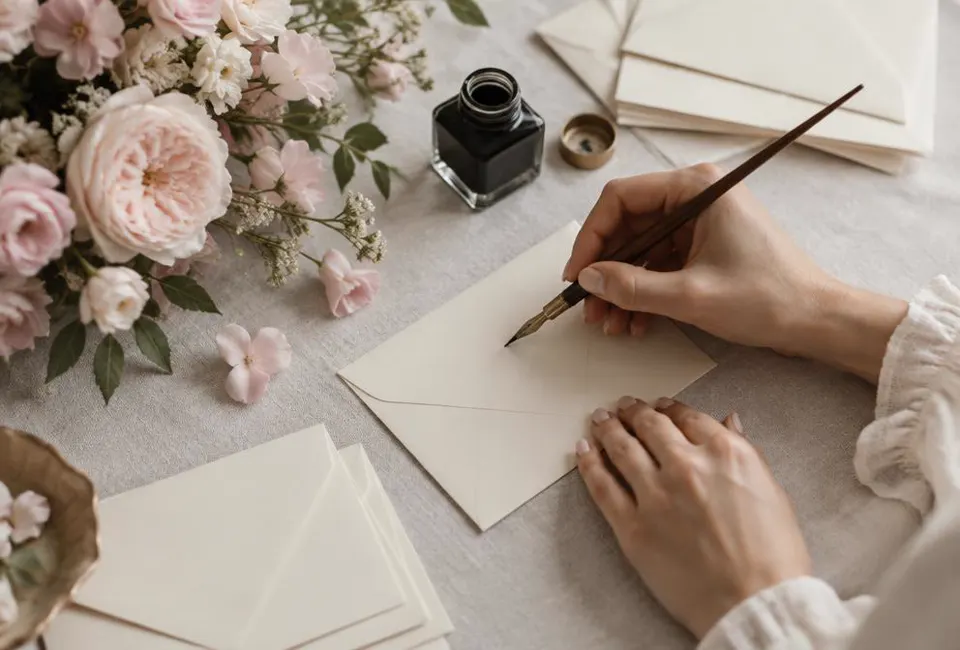
The Core Addressing Formula and Anatomy
Mastering how to address wedding invitations begins with understanding the physical structure of the stationery suite and the hierarchical rules of formal etiquette. This guide establishes the baseline standards for clarity and respect across all global postal systems.
The Anatomy of the Dual Envelope System
Traditional wedding stationery often employs a two-envelope system to protect the contents and clarify the guest list. The outer envelope serves as the functional mailing vessel. It must display the full legal names of the heads of the household and the complete delivery address. Conversely, the inner envelope remains unsealed and is tucked inside the outer one. Its primary purpose is to list every specific person invited, including children or a guest. For example, while the outer envelope for the Miller family might only list the parents, the inner envelope explicitly names each child to prevent confusion.
When preparing the outer envelope, formality is the universal standard. Use full names and titles rather than nicknames or initials. Instead of writing 'The Millers' or 'Mr. and Mrs. J. Miller,' etiquette dictates 'Mr. James and Mrs. Sarah Miller.' This approach ensures that the invitation is treated with the gravity the occasion deserves. If you are opting for a modern, single-envelope design, you must combine these roles by listing all invited guests clearly on the exterior, ensuring the post office and the recipients both understand exactly who is intended to attend.
| Component | Outer Envelope | Inner Envelope |
|---|---|---|
| Titles | Required (e.g., Mr., Dr.) | Required or Optional |
| Full Names | Required for Adults | First Names Only is Acceptable |
| Address | Full Postal Details | Omitted |
| Children | Generally Omitted | Listed by First Name |
| Plus Ones | Omitted | Listed as 'and Guest' |
The core formula for the address block requires the elimination of all abbreviations. This is a common area where couples stumble, often shortening 'Street' to 'St.' or 'Apartment' to 'Apt.' to save space. To maintain a high standard, you must spell out every word, including directional indicators like 'North' or 'West' and regional identifiers such as 'Province' or 'County.' For a couple like Mr. David Thompson and Ms. Elena Rossi living in London, the address should read 'Thames Street' rather than 'Thames St.' and 'London, Greater London' rather than 'London, Gld.'
Consistency in your layout is the final step in the foundational process. The recipient names should occupy the first line, followed by the street address on the second. If there is a secondary unit number, place it on its own line or at the end of the street line, separated by a comma. The final line should contain the city, state or province, and the postal code. This structured hierarchy helps postal workers and ensures your guests feel the personal touch of a well organized invitation from the moment it arrives in their mailbox.
Essential Formatting Rules for Global Addressing
- Use black or dark blue ink for maximum legibility and formality.
- Spell out all numbers under ten in street names, such as 'Fifth Avenue.'
- Place the return address on the back flap of the outer envelope.
- Ensure the guest names are centered horizontally on the envelope face.
- Do not use symbols like the ampersand unless it is part of a formal business title.
- Verify the spelling of all surnames against a confirmed guest list before writing.
Budgeting for these materials is a significant consideration for couples worldwide. While costs vary by region, recent data shows the average wedding spend is approximately US$33,000 according to The Knot Real Weddings Study 2025. In Australia, the average is about A$35,315 per Easy Weddings 2025, and Canada sits near C$30,000 according to RBC. Stationery typically accounts for about two to three percent of these totals. By mastering these core formulas early, you avoid the costly mistake of reordering envelopes due to etiquette errors or postal rejections.
Addressing Married and Unmarried Couples
When learning how to address wedding invitations, understanding the social nuances of couples is vital for showing respect to your guests. This section outlines the evolution from traditional formats to modern, inclusive styles for both married and unmarried partners.
For married couples who share a last name, the etiquette has shifted significantly in recent years. The traditional format, such as Mr. and Mrs. Michael Thompson, remains a classic choice for formal black tie events. However, many modern couples now prefer to see both first names recognized on the envelope. In these cases, you should list both individuals as Mrs. Sarah and Mr. Michael Thompson. This adjustment acknowledges the identity of both partners equally while maintaining the formal structure expected for a wedding. When writing these names, ensure the titles are consistent and the shared surname follows the final name mentioned.
Managing Unmarried Partners and Shared Households
Addressing unmarried couples who live together requires a different structural approach. Because they do not share a legal surname, each person must be listed on their own line to indicate their individual status. For example, you would write Ms. Jessica Miller on the first line and Mr. David Rivera on the second line. If you prefer to keep the address to a single line for space reasons, you may join them with the word and. In this scenario, etiquette suggests listing the person you are closest to first, or simply following alphabetical order by surname to remain neutral.
| Relationship Status | Outer Envelope Format | Inner Envelope (Optional) |
|---|---|---|
| Married (Traditional) | Mr. and Mrs. Michael Thompson | Mr. and Mrs. Thompson |
| Married (Modern) | Mrs. Sarah and Mr. Michael Thompson | Sarah and Michael |
| Unmarried (Cohabiting) | Ms. Jessica Miller and Mr. David Rivera | Jessica and David |
| Same-Sex Married | Mrs. Elena Cruz and Mrs. Sofia Varga | The Mesdames Cruz and Varga |
| Married (Wife keeps name) | Ms. Linda Grey and Mr. Robert Hall | Ms. Grey and Mr. Hall |
Alphabetical ordering is the safest default when you are unsure of the social dynamics between a couple. If you are inviting a couple where one partner has kept their maiden name, list them alphabetically by surname. For instance, if you are inviting Chloe Adams and Mark Zuber, Chloe would appear first. This method removes any perceived hierarchy and is considered highly professional. Avoid the common mistake of omitting titles like Mr. or Ms. unless the wedding is exceptionally casual, as these prefixes provide the necessary structure for a formal invitation suite regardless of the couple's marital status.
Consistency is the final key to a polished set of invitations. Once you choose a style, such as placing the woman's name first or using alphabetical order, apply that logic across your entire guest list. Mixed styles can make the set look disorganized. Remember that for married couples with different last names, the word and is used to signify their legal union. For unmarried couples, placing names on separate lines without the word and is a traditional way to signal that they are two distinct entities sharing a residence, though joining them with a conjunction is becoming more popular for space efficiency.
Quick Review for Couple Address Accuracy
- Confirm the spelling of both surnames for unmarried partners.
- Check if married women prefer their own first name or their husband's.
- Verify if the couple uses a hyphenated surname.
- Determine if the guest list will follow alphabetical or closeness logic.
- Ensure the word and is only used for committed or married couples.
- Verify that each guest has an appropriate prefix like Mr. or Ms.
- Check that two-line addresses are aligned to the left margin.
- Confirm that nicknames are avoided in favor of full legal names.
Navigating Professional Titles and Honours
When learning how to address wedding invitations, navigating the nuances of professional titles and earned honors ensures you show the proper respect to your most distinguished guests.
Professional titles carry a specific weight that dictates the hierarchy of names on an envelope. In formal etiquette, an earned title like Doctor, Captain, or The Honorable always takes precedence over social titles like Mr. or Ms. If one partner holds a professional designation while the other does not, the partner with the higher-ranking title is listed first, regardless of gender. For example, if Aris Varma is a physician and Leo Varma is not, the envelope should read Dr. Aris Varma and Mr. Leo Varma. This rule maintains the integrity of the achievement while acknowledging the partnership. In some regions, the title is spelled out in full for the most formal events, while Dr. is acceptable for standard formal mailings.
Handling Dual Professional Designations
Complications often arise when both members of a couple hold high-ranking titles. If both are doctors, you may address them as The Doctors Varma or Dr. Aris Varma and Dr. Leo Varma. If they hold different types of titles, such as a military rank and a medical degree, the military rank typically takes the lead position on the first line. For example, Captain Julian Reed and Dr. Sarah Reed. It is essential to research if one partner outranks the other within the same field. In a military context, the individual with the higher rank is always listed first. Accuracy here prevents social friction and demonstrates your attention to detail during the planning process.
| Guest Scenario | Outer Envelope Format | Inner Envelope Format |
|---|---|---|
| One Medical Doctor | Dr. Aris Varma and Mr. Leo Varma | Dr. Varma and Mr. Varma |
| Two Medical Doctors | The Doctors Varma | The Doctors Varma |
| Military Officer | Captain Elena Cruz and Mr. Jorge Cruz | Captain Cruz and Mr. Cruz |
| Judge or Official | The Honorable Justice Sam Lee and Mrs. Lee | Judge Lee and Mrs. Lee |
| Different Last Names | Dr. Aris Varma and Mr. Leo Miller | Dr. Varma and Mr. Miller |
Government officials and members of the judiciary require a specific prefix known as The Honorable. This applies to mayors, judges, and high-level representatives across many global jurisdictions. When addressing a judge, the outer envelope should use the full title, while the inner envelope or the informal salutation can revert to Judge. For instance, The Honorable Justice Marcus Thorne and Mrs. Thorne is the standard for the mailing address. If the official is the wife, she is listed first as The Honorable Jane Doe and Mr. John Doe. Ignoring these conventions can be seen as a sign of disrespect, particularly in formal legal or political circles where these distinctions are strictly observed.
For military personnel, specific branch traditions may apply, but the general rule is to use the rank followed by the name. If a guest is a retired officer, they still retain their rank for social purposes. You would address them as Colonel Robert Smith, Retired, or simply Colonel Robert Smith depending on the level of formality desired. It is important to note that academic degrees like PhDs are sometimes treated differently than medical degrees depending on the region. In North America and the UK, PhD holders may use Dr., whereas in some European countries, specific academic titles like Professor or Magister are preferred. Always verify the guest preference to avoid unintended slights.
Title Accuracy Checklist
- Confirm if the medical doctor is a PhD or an MD to match their preference.
- Verify current military ranks for active duty service members.
- Check if a retired officer still uses their rank in social settings.
- List the partner with the higher professional rank first.
- Use The Honorable for all active judges and high-level elected officials.
- Spell out Doctor or Professor for ultra-formal wedding invitations.
- Ensure pluralization is correct, such as The Doctors or The Professors.
- Verify if both partners share a last name or use separate surnames.
- Double check the spelling of non-standard professional abbreviations.
Navigating these titles requires a methodical approach to your guest list. While wedding costs vary globally, such as the US average of about $33,000 according to The Knot Real Weddings Study 2025 or Australia's A$35,315 per Easy Weddings 2025, the cost of printing invitations remains a small fraction of the total budget. However, the social cost of a misaddressed envelope can be significant. Spend time verifying the specific honors of your guests early in the planning phase. By applying these hierarchy rules consistently, you ensure that every guest, from the local mayor to a career military officer, feels correctly recognized and welcomed to your celebration.
Handling Families and Households with Children
Determining how to address wedding invitations for households with children requires a balance of warmth and clarity to ensure your guest count remains manageable. This section outlines the specific formulas used to signal whether the entire family is welcome or if the event is restricted to adults.
When you intend for the entire household to attend, the outer envelope serves as the primary indicator of your hospitality. The most concise method is to address the envelope to The Miller Family, which universally implies that every person living at that residence is invited. If you prefer a more formal approach that recognizes the children individually, list the parents on the first line and the children on the second line in order of age. For example, you might write Mr. and Mrs. Miller on line one, followed by Clara, Leo, and Sophie on line two. This eliminates any ambiguity regarding who is expected at the celebration.
Strategies for Adult Only Celebrations
If your wedding is an adults only event, the addressing must be precise to avoid social friction and unexpected guests. Instead of using collective terms like The Rodriguez Household, you should list only the specific names of the adults you are inviting, such as Mr. Carlos Rodriguez and Ms. Elena Soto. By omitting the names of children or collective family titles, you provide a subtle but clear signal. If you feel additional clarity is needed for your specific social circle, you can reinforce this on the inner envelope or the response card by stating that you have reserved two seats in their honor.
A common mistake in how to address wedding invitations involves using the phrase and Family when you only intend to invite certain children. If a household has four children but you only have space for the two oldest who are friends with your own children, you must list those two specific names. Using and Family technically opens the door for every sibling and potentially live in relatives. To maintain boundaries, always default to individual names rather than broad categories. This ensures that your guests understand the invitation is specific to the names written on the envelope.
Formulas for Children and Teenagers
- For boys under 18: Use the title Master followed by their name, or simply their first name.
- For girls under 18: Use the title Miss followed by their name, or simply their first name.
- For children over 18 living at home: They should technically receive their own separate invitation to recognize their adulthood.
- For a household with different surnames: List the parents first, then the children, such as Ms. Sarah Jenkins, Mr. David Lee, and Leo Lee.
- If using an inner envelope: You may list the parents on the outer envelope and just the children's first names on the inner envelope.
- For informal events: Omit titles entirely and list names as Parents First Names and Children First Names.
When dealing with complex family structures, such as split households or stepchildren, send the invitation to the primary residence where the children spend the majority of their time. If the children split their time equally, it is a thoughtful gesture to send the invitation to the parent with whom you are closest, while naming the children clearly. If you are inviting stepchildren who do not live with the primary guest full time, still include their names on the envelope to show they are recognized as part of the family unit. Clear naming conventions prevent guests from feeling overlooked or confused.
| Scenario | Envelope Recipient Line | Resulting Guest Count |
|---|---|---|
| Whole family invited | The Miller Family | All residents |
| Parents only | Mr. and Mrs. Miller | Two adults |
| Specific children invited | Mr. Miller, Mrs. Miller, and Leo | Three people |
| Adults only (Unmarried) | Ms. Elena Soto and Mr. Carlos Rodriguez | Two adults |
| Teenagers included | The Rodriguez Household: Carlos, Elena, and Sofia | Three people |
Consistency is the final key to success when managing family invitations. Once you decide on a rule, such as no children under age twelve, apply it across all invitations to avoid perceptions of favoritism. If guests call to ask for exceptions, you can politely refer to the names listed on the envelope. By following these specific formulas for how to address wedding invitations, you provide guests with the information they need to make childcare arrangements well in advance, leading to a smoother experience for everyone involved in the celebration.
Addressing Single Guests and Plus One Scenarios
Understanding how to address wedding invitations for solo guests ensures your guest list remains manageable while showing respect for your friends' personal relationships.
When inviting a single guest who is not in a committed relationship, the standard protocol is to use their full name and title on both the outer and inner envelopes. For a female guest, use Ms. unless you are certain she prefers Miss. For a male guest, use Mr. This approach identifies the specific individual invited and subtly signals that the invitation is intended for them alone. By omitting any mention of a guest or partner, you establish a clear boundary that helps prevent uninvited additions to your final headcount, which is vital for budget management. According to the Bridebook 2024 report, UK weddings average about £20,600, so controlling the guest count is a practical necessity.
Formalizing the Plus One and Known Partners
If you choose to allow a solo guest to bring a companion whose name you do not know, the phrase and Guest is the universal standard. This should be written on the inner envelope to maintain the formal aesthetic of the outer mailing envelope. However, if your guest is in a long term or established relationship, etiquette dictates that you must research the partner's name. Addressing the envelope to Ms. Jenna Lee and Mr. David Smith recognizes the validity of their partnership. This effort prevents the social friction that occurs when a long term partner is treated as a generic plus one, and it ensures your seating chart reflects accurate names from the start.
| Guest Scenario | Outer Envelope Script | Inner Envelope Script |
|---|---|---|
| Truly Solo Guest | Ms. Sarah Jenkins | Ms. Jenkins |
| Solo with Unknown Guest | Mr. Robert Vance | Mr. Vance and Guest |
| Unmarried Couple | Ms. Jenna Lee and Mr. David Smith | Ms. Lee and Mr. Smith |
| Same Sex Unmarried Couple | Mr. Alex Thorne and Mr. Leo Grant | Mr. Thorne and Mr. Grant |
| Guest with a Doctor Partner | Ms. Elena Rossi and Dr. Marc Webb | Ms. Rossi and Dr. Webb |
The placement of names for unmarried couples follows a simple hierarchy. Generally, the names are listed alphabetically by surname. If you are closer to one individual, their name may appear first. Each name should occupy its own line if the names are long, or be joined by the word and on a single line. Never use a slash or a comma to separate the names, as these symbols lack the formality required for a wedding. This specific formatting helps the couple understand that both individuals are invited by name, which effectively closes the door to them bringing a different third party instead of the named partner.
Accuracy in these details is especially important when considering the global variations in wedding costs. For example, Easy Weddings 2025 reports Australia weddings average about A$35,315, while The Knot Real Weddings Study 2025 shows the US average is about $33,000. These significant investments mean that every seat counts. When you address an invitation to a specific individual and their named partner, you are making a deliberate choice. If a guest asks to bring someone else, you can politely refer back to the specific names listed on the envelope. This transparency reduces confusion and helps maintain the intended atmosphere of your celebration.
Decision Framework for Single Guests
- Identify if the guest is in a committed relationship of six months or more.
- Search social media or ask mutual friends to confirm the correct spelling of a partner's name.
- Determine if your venue capacity allows for generic plus ones.
- Apply the and Guest script only to those who are truly single or if you have never met the partner.
- Verify professional titles like Dr. or Professor for the partner to ensure equal respect.
- Double check the spelling of both surnames before printing to avoid offending the guest.
Plus One and Solo Guest Accuracy Checklist
- Confirm every partner name is spelled correctly.
- Use Ms. as the default for solo female guests.
- Avoid using and Guest on the outer envelope.
- List names alphabetically for unmarried couples.
- Check that the inner envelope matches the specific guest count.
- Ensure no children are implied if the guest has a family.
- Verify the partner's preferred title.
- Use separate lines for long names to maintain clarity.
International Variations and Postal Standards
As modern weddings increasingly bridge geographical borders, mastering international postal standards is essential for ensuring your invitations reach every guest. This section provides the technical framework for formatting addresses to accommodate the specific requirements of major global regions.
When mailing invitations across international borders, the bottom line of the address block must exclusively contain the name of the country. To assist automated sorting systems and prevent delivery delays, this country name should be written in all capital letters. For example, if you are mailing an invitation from London to a friend in Tokyo, the final line should simply read JAPAN. Avoid adding zip codes or city names to this final line. Placing the country clearly at the base ensures that the originating postal service immediately identifies the correct outbound dispatch stream for your stationary.
Formatting Standards for Canada and Australia
For guests located in Canada, the address format closely resembles the US style but requires a specific alphanumeric postal code. The postal code should be placed on the same line as the city and province, separated by two spaces. For example: Mr. Leo Vance and Ms. Sarah Miller, 456 Maple Avenue, Toronto ON M5V 2T6, CANADA. Similarly, for Australian guests, the suburb, state abbreviation, and four digit postcode appear on the same line. An invitation to Sydney would be addressed: Mr. and Mrs. Julian Banks, 12 Harbour Street, Sydney NSW 2000, AUSTRALIA. Using these specific regional markers prevents the mail from being flagged as incomplete.
European addresses often place the postal code before the city name, which is a reversal of the North American standard. In countries like France or Germany, the house number may also follow the street name rather than preceding it. For a couple in Berlin, the format would be: Mr. Klaus Schmidt and Mr. Hans Weber, Kantstraße 12, 10623 Berlin, GERMANY. In the United Kingdom, the postcode is usually placed on its own line above the country. Accuracy here is vital, as international postage costs can be significant. For context, Canadian couples typically spend C$30,000 (RBC) on their celebrations, and ensuring invitations arrive safely protects that initial investment.
| Region | Sample Couple | Street Format | City/Code Line |
|---|---|---|---|
| United Kingdom | Mr. Arthur Prynne | 22 Baker Street | London NW1 6XE |
| France | M. et Mme. Dupont | 15 Rue de Rivoli | 75004 Paris |
| Australia | Dr. Fiona Gills | 88 George St | Brisbane QLD 4000 |
| Canada | Mr. Simon Lee | 789 Main St | Vancouver BC V6B 1A1 |
A common mistake in international addressing is using local abbreviations for countries, such as writing UK or USA. To meet universal postal standards, always use the full, formal name of the destination country. If you are sending a large volume of international mail, consider the weight of your invitation suites. Heavy cardstock and multiple inserts can move your envelope into a higher weight bracket, increasing the cost per unit. With Australian weddings averaging A$35,315 (Easy Weddings 2025), budget management includes being precise with postage to avoid having a whole batch returned for insufficient funds.
Global Mailing Accuracy Checklist
- Write the destination country in all capital letters on the final line.
- Use the full name of the country rather than abbreviations.
- Ensure the alphanumeric postal code for Canada includes a space in the middle.
- Place the UK postcode on its own line above the country name.
- Verify if the house number should follow the street name for European guests.
- Check that the return address follows the format of your own country.
- Use a dark, high contrast ink for legibility on colored envelopes.
- Confirm the correct state or province abbreviation for the destination.
- Weigh a full invitation suite at the post office before buying stamps.
Finally, remember that international transit times vary greatly. While domestic mail might arrive in three days, international pieces can take two to three weeks. In the UK, where weddings average £20,600 (Bridebook 2024) to £23,000 (Which? 2024), planners often recommend sending international invitations two weeks earlier than domestic ones. This ensures all guests, regardless of their location, have an equal amount of time to arrange travel and RSVP. Double checking the spelling of foreign street names and suburbs will prevent your invitations from becoming lost in local delivery networks due to phonetic errors.
Practical Execution and Common Pitfalls
The final stage of how to address wedding invitations involves transitioning from your list of names to the physical stationery. This phase requires meticulous attention to detail to ensure your aesthetic efforts are not undermined by logistical errors.
Before you begin the writing process, apply the ten percent rule for your stationery order. Even the most experienced calligraphers or focused couples will encounter ink blots, spelling errors, or smudges. If you have one hundred households on your guest list, you should order at least ten additional envelopes. This buffer prevents the stress of reordering small batches, which often incurs high shipping fees and potential color mismatches between print runs. Having these spares allows you to discard mistakes immediately rather than attempting to correct them with unsightly white out or scrapers.
Calligraphy versus Digital Labels
For formal weddings, the method of addressing is as important as the wording itself. A common pitfall is using adhesive mailing labels, which can appear impersonal and overly commercial for a milestone event. Traditional etiquette suggests that all envelopes be hand addressed. If your budget does not allow for a professional calligrapher, choose a high quality pen and write the names yourself. For modern or casual events, printing addresses directly onto the envelope using a font that matches your suite is an acceptable alternative to labels. This maintains a cohesive design while saving significant time during the preparation phase.
Accuracy in the physical execution prevents social friction. Consider a scenario involving Mr. Julian Vance and Dr. Elena Vance. If you accidentally address the envelope to Mr. and Mrs. Vance, you negate Elena's professional achievement and potentially cause offense. A decision framework for checking your work should involve a two person review system. One person reads the name and address aloud from the master list while the second person verifies the spelling on the finished envelope. This cross referencing catches transposed numbers in postal codes and subtle spelling errors in surnames that one person might overlook alone.
| Pitfall | Consequence | Recommended Solution |
|---|---|---|
| Using Abbreviations | Diminished formality | Spell out Street, Avenue, and State names fully. |
| Incorrect Ink Choice | Smudging or illegibility | Use waterproof pigment ink rather than standard dye ink. |
| Seal Placement | Torn envelopes in machines | Place wax seals on the inner envelope or use a protective outer layer. |
| Missing Return Address | Undeliverable mail lost | Print the return address on the back flap of every envelope. |
| Wrong Sequence | Name confusion | Ensure the most senior title is listed first regardless of gender. |
Budgeting for these details is essential as you finalize your plans. According to The Knot Real Weddings Study 2025, the average US wedding costs about $33,000. In the UK, Bridebook 2024 reports costs around £20,600, while Which? 2024 cites £23,000. Australian couples spend about A$35,315 according to Easy Weddings 2025, and Canadian weddings average C$30,000 per RBC. Allocating a small percentage of these totals specifically for high quality ink, extra envelopes, and verified postage ensures that the first impression your guests receive is professional and polished. Taking the time to execute this step correctly reflects the importance of the occasion.
Final Mailing Readiness Checklist
- Verify that all house numbers and postal codes are legible.
- Check that the internal guest names match the outer envelope exactly.
- Confirm that the weight of the full suite does not exceed postage limits.
- Test your ink on a spare envelope to ensure it does not bleed through.
- Ensure all stamps are placed straight and in the top right corner.
- Count the finished envelopes against your master list to ensure no one is missed.
- Double check the spelling of professional titles like Honorable or Professor.
- Remove any stray pencil marks used for lining up your handwriting.