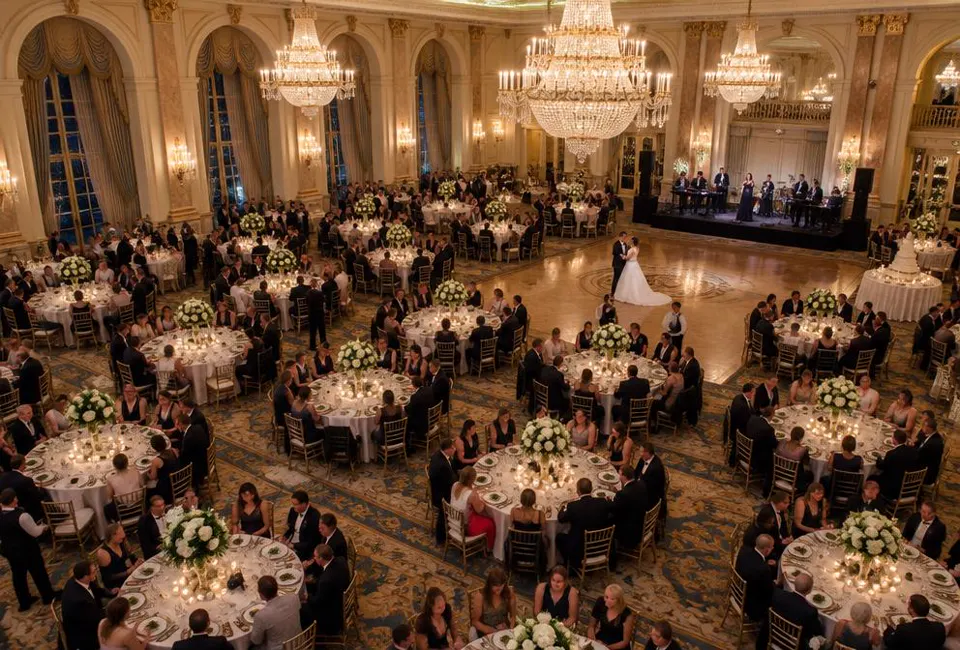
Defining Scale and Global Budget Realities
Learning how to plan a large wedding begins with a grounded assessment of your financial starting point and the logistical scale of hosting a high guest count. By establishing a realistic global baseline, you can move from abstract dreaming to precise resource allocation.
Before selecting a venue or signing a florist contract, you must establish a financial foundation using regional benchmarks. Data reflects the high costs of contemporary celebrations. In the United States, the average wedding cost is about $33,000 according to The Knot Real Weddings Study 2025. In Australia, figures reach about A$35,315 based on Easy Weddings 2025 research. Canadian couples face costs of about C$30,000 according to RBC. In the United Kingdom, costs range from about £20,600 per Bridebook 2024 to £23,000 according to Which? 2024. These numbers represent baseline averages, but for a large wedding, your specific total will likely scale upward based on per person costs.
The Fifty Percent Allocation Formula
Managing a massive guest list requires a rigid percentage based allocation formula to prevent overspending in secondary categories. Regardless of your total currency amount, you should allocate 50 percent of the total budget to venue rental and catering. This half of your funds ensures the primary guest experience, covering the food, drinks, and the physical space required for a large crowd. The remaining 50 percent should be split among photography, attire, entertainment, and decor. A common mistake is spending 20 percent on a designer gown or custom tuxedo before securing a venue large enough to hold everyone, which later forces couples to cut guest numbers.
| Category | Allocation Percentage | Includes |
|---|---|---|
| Venue and Catering | 50 percent | Rentals, food, service, and open bar |
| Photography and Video | 12 percent | Full day coverage and albums |
| Decor and Flowers | 10 percent | Centerpieces, lighting, and installations |
| Music and Tech | 8 percent | Band, DJ, and sound reinforcement |
| Attire and Beauty | 8 percent | Gown, suit, hair, and makeup |
| Buffer and Misc | 12 percent | Stationery, transport, and emergencies |
Consider a hypothetical scenario featuring a couple named Sarah and Mateo who are planning a celebration for 250 guests. They initially budgeted $30,000, but upon seeing the US average of $33,000 from The Knot Real Weddings Study 2025, they realized their large guest list required a higher ceiling. By applying the 50 percent rule, they earmarked $16,500 specifically for their reception site and dinner. This forced them to use a script when negotiating: We love this ballroom, but our catering cap is $66 per person including service. Can we adjust the menu to fit that number? This approach kept their planning focused on the guests.
Finally, remember that scale dictates complexity. A wedding for 300 people is not just three times the cost of a 100 person wedding: it often requires additional staff, larger sound systems, and more robust transport. You must build a 10 percent buffer into your global budget specifically to handle these scaling issues. By defining your financial limits early using data from sources like Bridebook 2024 or Easy Weddings 2025, you ensure the planning process remains joyful rather than a source of financial strain. Clarity at the start is the most effective tool for long term success.
Pre-Planning Budget Checklist
- Identify your total available funds from all contributors
- Apply the 50 percent rule to determine your catering ceiling
- Research local venue averages to verify your regional data
- Calculate the all inclusive per person cost including tax
- Set aside a 10 percent contingency fund for unexpected fees
- List your top three non negotiable priorities for spending
- Determine a hard cap for the maximum guest count allowed
- Draft a budget tracking document in a shared spreadsheet
The Tiered Guest List Decision Framework
Developing a structured approach to your guest list is the only way to maintain order when the count climbs into the hundreds. This section provides the specific logic needed to filter your social circle while preserving your budget and venue capacity.
When learning how to plan a large wedding, the Tiered Guest List Framework acts as your primary filter. The A List consists of non-negotiable guests: immediate family, the wedding party, and closest friends who are in constant contact. The B List includes extended family and social groups you see regularly but could feasibly celebrate without if space were tight. Finally, the C List contains coworkers, distant relatives, or old acquaintances. You only send invitations to the B and C lists as declines from the A list arrive. This staggered approach ensures you hit your target number without exceeding the venue fire code or your per-head catering budget.
The Headcount Estimation Formula
Large weddings rarely see one hundred percent attendance, especially when guests must travel across borders. A reliable formula for estimating your final headcount involves applying a 15 to 20 percent decline rate to your total invited list. For example, if Sarah and Mark invite 300 people, they should prepare for approximately 240 to 255 attendees. However, if more than 50 percent of the guests are local, the decline rate often drops to 10 percent. Couples should always provide the caterer with the lower estimate initially to avoid paying for empty seats, as most contracts allow you to increase the count later but rarely decrease it without penalty.
| Tier Level | Target Group | Attendance Probability | Action Strategy |
|---|---|---|---|
| A List | Inner Circle | 90 to 95 percent | Send invitations in first wave |
| B List | Regular Friends | 70 to 85 percent | Invite as A-list declines arrive |
| C List | Acaintances | 50 to 60 percent | Only invite if under capacity |
| Out of Town | International | 30 to 50 percent | Account for high travel costs |
Managing the expectations of distant relatives regarding children is a common hurdle for large events. If Sarah and Mark decide on an adult-only celebration to keep the count manageable, they must use clear and firm language. A script they might use via phone or email is: We are so excited to celebrate with you. Because we are managing a very large guest list to accommodate all our extended family, we have chosen to host an adults-only event. We hope you understand that we cannot accommodate children at the venue, and we would love to see you there if you can make it work. This keeps the focus on the scale of the wedding rather than personal preferences.
Consistency is the most important rule when enforcing your tiers. If you allow one cousin to bring children or a plus one but deny another, it creates social friction that can overshadow the celebration. Stick to the logic of your framework. For instance, you might decide that plus ones are only granted to guests who are married, engaged, or in long-term cohabiting relationships. By applying these rules universally across your A, B, and C lists, you remove the emotion from the decision and can point to a standard policy if anyone questions their invitation status or the lack of an extra guest.
Guest List Management Essentials
- Categorize every name into A, B, or C tiers immediately
- Verify current mailing addresses for all international guests
- Apply the 15 percent decline formula to your total list
- Set a firm deadline for B list invitation mailings
- Draft a standard response script for uninvited plus ones
- Check venue capacity limits against the total A list count
- Account for professional vendors in your final meal count
- Cross reference the list with your budget per head
- Confirm the RSVP date is at least five weeks before the event
Evaluating High Capacity Venues
When you learn how to plan a large wedding, the venue choice shifts from an aesthetic decision to a complex logistical calculation regarding guest movement. A high capacity space must accommodate peak density during cocktails while providing enough square footage for seated dining without feeling cramped.
The primary metric for a large event is the flow of the crowd. You must account for approximately 1.4 to 1.8 square meters per person for a seated dinner with a dance floor. Wide aisles are non negotiable for groups exceeding two hundred guests. If aisles are narrower than two meters, guest movement to the buffet or restrooms becomes a bottleneck that disrupts the event timeline. Ensure that the floor plan allows for clear sightlines to the head table, as large pillars or awkward L shaped rooms can make guests in the back feel disconnected from the ceremony and speeches.
Essential Infrastructure and Sanitation
Infrastructure requirements scale exponentially with guest count. One of the most common mistakes in large scale planning is underestimating restroom ratios. You should aim for at least one toilet for every forty to fifty guests to avoid long queues during the transition from dinner to dancing. Furthermore, evaluate the electrical capacity of the space. Large weddings often require significant power for professional lighting rigs, live bands, and catering equipment. A venue that lacks dedicated circuits for vendors will require the additional cost of rented generators, which can impact your overall budget management.
| Guest Count | Minimum Square Footage | Required Toilets | Minimum Aisle Width |
|---|---|---|---|
| 200 Guests | 3,000 to 3,500 sq ft | 4 to 5 Units | 1.5 Meters |
| 350 Guests | 5,250 to 6,000 sq ft | 7 to 9 Units | 2.0 Meters |
| 500 Guests | 7,500 to 9,000 sq ft | 10 to 12 Units | 2.5 Meters |
| 750 Guests | 11,250+ sq ft | 15+ Units | 3.0 Meters |
Elena and David are currently navigating this choice for their four hundred guest wedding. They are torn between a modern hotel ballroom and a historic private estate. While the estate offers stunning outdoor views, the couple discovered that the electrical load cannot support their twelve piece band and the catering team simultaneously. Additionally, the estate only has three permanent restrooms, necessitating the rental of luxury portable trailers. In contrast, the hotel ballroom offers dedicated loading docks for vendors and built in industrial power grids. For Elena and David, the hotel provides superior vendor access that simplifies the setup process significantly.
Vendor access is the hidden hurdle of high capacity venues. A private estate might require all rentals to be shuttled down a narrow driveway, which increases labor hours and costs. In contrast, a purpose built ballroom usually features service elevators and wide loading bays. When touring a potential site, ask to see the service entrance. If a venue has only one small elevator for a ten person catering crew and a floral team, the setup will inevitably run behind schedule. Prioritizing logistics over initial visual appeal ensures that the actual wedding day runs smoothly for everyone involved.
High Capacity Venue Technical Audit
- Verify the venue has a minimum of one restroom per fifty guests.
- Measure main aisles to ensure they are at least two meters wide.
- Confirm the total square footage allows for 1.5 square meters per guest.
- Check for dedicated vendor electrical circuits of at least twenty amps.
- Inspect the loading dock for height and width clearance for rental trucks.
- Evaluate the foyer size to ensure it can hold 100 percent of guests for cocktails.
- Identify any structural pillars that might block sightlines for large groups.
- Ask for a sample floor plan showing the placement of forty plus tables.
- Ensure there are at least two distinct exit points for emergency safety.
Finally, consider the acoustic properties of the room. Large spaces with high ceilings and hard surfaces like marble or glass can create an echo that makes speeches unintelligible. A venue with acoustic dampening or carpeting is often better for groups where communication is key. If you choose a site with poor acoustics, you must budget for a professional sound technician to manage levels throughout the evening. Choosing a venue that handles sound and movement efficiently allows you to focus on the celebration rather than managing traffic jams or technical failures during the reception.
Efficient Catering and Beverage Formulas
Coordinating food and drink for a high headcount requires a shift from boutique dining to industrial efficiency. When learning how to plan a large wedding, the primary goal is ensuring all guests are served within a tight window to maintain the event momentum.
The choice between plated service and buffet styles often dictates the flow of the entire evening. A plated dinner offers a refined experience but requires a massive staffing ratio of roughly one server per ten guests to ensure simultaneous delivery. For a 200 plus guest list, this can lead to the last table receiving food as the first table finishes. Conversely, a buffet can be faster if managed with double sided access and multiple stations. Consider the case of Maya and Liam, who hosted 300 guests. By utilizing four separate buffet stations with identical offerings, they reduced the total service time to forty minutes, allowing the party to transition to dancing ahead of schedule.
Calculating Beverage Volumes for Large Crowds
Underestimating the bar requirements is a common pitfall that leads to early closures or unexpected mid event runs to the store. A reliable formula for a large wedding is to provide one drink per person per hour for the duration of the reception. Once you have this baseline, add a 20 percent buffer to account for heavy drinkers or spilled glasses. For a five hour reception with 250 guests, the calculation starts at 1,250 drinks. Adding the 20 percent buffer brings the total to 1,500 servings. This ensures the bar remains stocked even if the crowd prefers one specific spirit over others throughout the night.
Strategies for Reducing Bar Wait Times
- Implement the Batch Cocktail strategy by pre mixing two signature drinks in large dispensers or carafes.
- Set up a dedicated beer and wine station away from the main bar to divert simple orders.
- Utilize a 1:50 bartender to guest ratio to prevent lines from exceeding five minutes.
- Pre pour a round of sparkling wine or a non alcoholic welcome drink for guests as they enter the reception.
- Ensure all garnishes and glassware are prepped in double quantities before the cocktail hour begins.
- Use signage to clearly display the drink menu so guests decide their order before reaching the front.
When managing global budgets, catering is typically the largest expense. The Knot Real Weddings Study 2025 notes the US average is about $33,000, while Bridebook 2024 cites UK costs around £20,600. For large groups, every dollar or pound counts. A common mistake is offering too many menu choices, which complicates the kitchen logistics. Streamlining to two protein options and one vegetarian dish allows the culinary team to focus on quality and speed. This simplicity is vital when attempting to serve hundreds of hot meals in a short window without compromising food safety or presentation standards.
| Service Type | Speed Level | Staffing Needs | Cost Impact |
|---|---|---|---|
| Plated Service | Slow to Moderate | High (1:10 ratio) | Higher Labor Costs |
| Standard Buffet | Slow (Single Line) | Low to Moderate | Moderate |
| Multi-Station Buffet | Fast | Moderate | Mid-Range |
| Family Style | Moderate | High (Platter heavy) | Higher Food Waste |
Effective logistics extend to the final courses. For dessert, a large wedding benefits from a central display rather than a seated service. This encourages guests to move around and socialize after a long seated meal. If you choose a traditional cake, have it pre sliced in the kitchen to avoid a bottleneck at the cake table. By treating the catering plan as a flow chart of movement, you ensure that the volume of guests never translates into a stagnant or frustrating experience for your friends and family.
Streamlining Guest Communication and RSVPs
Managing a high volume of guests requires a shift from manual record keeping to automated systems to avoid logistical errors. Effective communication ensures that hundreds of attendees receive consistent information without overwhelming the couple with repetitive inquiries.
When you are learning how to plan a large wedding, the sheer volume of data makes traditional paper tracking risky. Digital RSVP systems are essential for weddings exceeding one hundred guests. These platforms allow couples to export spreadsheets that filter dietary restrictions and table assignments instantly. For example, a couple named Elena and Marcus used a digital dashboard to categorize their 350 guests into groups such as family, colleagues, and out of town visitors. This prevented them from losing track of physical response cards and allowed them to send targeted email reminders to specific segments of their list without bothering those who had already replied.
The Role of a Comprehensive Wedding Website FAQ
A detailed Frequently Asked Questions page acts as a primary customer service tool for your guests. Instead of answering individual texts about parking or dress codes, you can direct everyone to a central resource. Large weddings often involve complex logistics like shuttle schedules or multiple venue entries. Your FAQ should address child policies, local transport options, and specific arrival times for the ceremony. A common mistake is being too brief. Providing specific details, such as the walking distance between the ceremony and reception or the availability of coat checks, reduces the number of direct questions you will receive as the date nears.
| Weeks Before Wedding | Action Item | Target Completion | Goal |
|---|---|---|---|
| 8 to 10 Weeks | Send Invitations | Week 10 | Initiate Guest Awareness |
| 4 Weeks | RSVP Deadline | End of Week 4 | Collect 85 percent of responses |
| 3 Weeks | Direct Outreach | End of Week 3 | Contact all non responders |
| 2 Weeks | Final Catering Count | Day 14 | Submit precise numbers to venue |
| 1 Week | Seating Chart Finalized | Day 7 | Print escort cards and maps |
Executing the follow up phase requires a systematic approach to ensure the caterer receives an accurate headcount. If the RSVP deadline passes and you are missing 50 responses, you must initiate a three day phone tree. Start with a polite text or email, then move to a phone call if there is no reply within 48 hours. Use a script like this: Hello, we are finalizing the seating and meal counts for our wedding and wanted to ensure you can still join us. Please let us know by tomorrow evening so we can include you in the final count for the venue. This prevents paying for empty seats or having insufficient food.
Global cost averages highlight why accuracy is vital. In Australia, the average wedding cost is about A$35,315 according to Easy Weddings 2025. In Canada, the average is about C$30,000 as reported by RBC. Every uncounted guest who arrives unexpectedly, or every guest you pay for who does not show up, creates a significant financial discrepancy. By utilizing digital tools, you can ensure that your final guest list aligns perfectly with your budget. This precision is especially important when dealing with the high per head costs associated with large scale catering and venue rentals across different international markets.
RSVP and Communication Audit
- Verify that the digital RSVP link is mobile friendly for all guests.
- Test the dietary restriction drop down menu for clarity.
- Include a map link for the ceremony and reception on the FAQ page.
- Assign a family member to call elderly guests who may struggle with digital forms.
- Cross reference the final guest list against the room block report.
- Set an automated reminder email for 72 hours before the RSVP deadline.
- Ensure the website clearly states the plus one policy to avoid confusion.
- Verify that the catering manager has received the final spreadsheet by the deadline.
Mass Transportation and Room Blocks
When learning how to plan a large wedding, managing the physical movement of hundreds of people becomes as critical as the ceremony itself. Efficient room blocks and synchronized transport prevent logistical bottlenecks that can derail your schedule.
Managing a high guest count requires a multi hotel strategy for room blocks. When a guest list exceeds one hundred rooms, relying on a single hotel often creates availability risks or limits price point options for your guests. To negotiate effectively, contact the sales managers at three different hotels within a five kilometer radius. Request a courtesy block first, which holds fifteen to twenty rooms without a financial deposit. For larger requirements, you may need a guaranteed block where you are liable for a percentage of unbooked rooms. Negotiate for complimentary perks like a suite upgrade for the couple or free shuttle service based on the total room nights booked by your group.
Shuttle Logistics and Buffer Timing
Movement logistics are best managed through a continuous loop system rather than a single trip. Consider a scenario involving a couple, Sarah and David, who have three hundred guests staying across two hotels. Instead of hiring six small vans, they hire three fifty passenger coaches. The first coach departs forty five minutes before the ceremony, while the final coach leaves fifteen minutes before the start time. This staggered approach accounts for the reality that guests rarely arrive downstairs at the same time. By building in a twenty minute buffer between the final shuttle arrival and the processional, the couple ensures that latecomers do not interrupt their entrance.
The buffer time is essential because large groups move slowly. Loading a fifty seat bus can take ten minutes, and unloading at a narrow venue entrance can take even longer. If your venue is located in a high traffic urban area, increase your travel time estimates by thirty percent. For international weddings, remember that global costs vary significantly. For context on total wedding investment, the US average is about $33,000 according to The Knot Real Weddings Study 2025, while the UK average ranges from £20,600 per Bridebook 2024 to £23,000 according to Which? 2024. Logistics typically consume five to ten percent of these global budgets for large scale events.
| Guest Count | Vehicle Type | Number of Vehicles | Total Capacity per Loop |
|---|---|---|---|
| 150 to 200 | Executive Mini Coach | 3 | 90 to 105 |
| 200 to 300 | Full Size Motorcoach | 3 | 165 |
| 300 to 450 | Full Size Motorcoach | 5 | 275 |
| 450 plus | Mixed Fleet | 6 plus | 330 plus |
Communication is the final pillar of mass transportation. Provide a clear transport schedule on your wedding website and print physical cards to be handed out at hotel check in. These cards should list the exact pickup locations, departure times, and a contact number for a transport coordinator. Avoid listing the couple or the wedding party as the point of contact. Instead, designate a professional coordinator or a trusted family member who is not in the processional to manage the drivers. This ensures that if a bus is delayed or a guest is lost, the couple remains focused on the ceremony itself.
Transportation and Lodging Logistics Checklist
- Compare price points across three hotels to accommodate different guest budgets.
- Review the attrition clause in room block contracts to understand financial liability.
- Confirm vehicle access heights and turning radii at the venue entrance.
- Book shuttles for a minimum of two hours before the ceremony and four hours during the reception exit.
- Designate a specific onsite contact for shuttle drivers who is not the bride or groom.
- Provide clear signage in hotel lobbies directing guests to the wedding shuttle pickup point.
- Include a thirty percent time buffer for traffic or slow boarding during peak hours.
- Verify that transport companies have valid insurance and local operating permits.
- Confirm if the hotel offers a complimentary shuttle for smaller groups under fifty people.
Scaling Decor for Large Spaces
When learning how to plan a large wedding, the biggest challenge is preventing a cavernous ballroom from feeling empty or cold. Successful couples use scale and light to fill the volume of a room without exhausting their entire floral budget.
Large venues present a unique paradox: small arrangements that look beautiful on a dining table often disappear when placed in a room with twenty foot ceilings. To combat this, couples like Sofia and Mateo utilized the High-Low centerpiece technique. By placing tall, architectural arrangements on 40 percent of the tables and low, lush clusters on the remaining 60 percent, they created a dynamic skyline across the reception hall. This approach draws the eye upward to fill the vertical void while keeping the overall floral costs manageable. It ensures that the room feels intentionally designed rather than sparsely decorated with uniform, mid-sized pieces.
Prioritizing Illumination Over Floral Density
In a grand hall, the cost of filling every corner with fresh flowers is often prohibitive. According to The Knot Real Weddings Study 2025, the US average wedding cost is about $33,000, and spending a disproportionate amount on greenery can break this budget. Instead, professional planners recommend investing in pin spotting and uplighting. Pin spotting uses narrow beams to illuminate centerpieces, making even modest arrangements pop against a dim room. Uplighting along the perimeter walls changes the architectural feel of the space for a fraction of the cost of physical decor. Light occupies volume for free once the fixtures are placed.
Large scale decor also benefits from the use of non floral elements that provide height. Consider using tall manzanita branches, dried pampas grass, or even hanging installations. Sarah and David, a couple in Australia, faced the A$35,315 average cost cited by Easy Weddings 2025. They saved thousands by using tall, reusable gold stands topped with voluminous greenery rather than premium blooms. The greenery provided the necessary mass to match the room's scale, while the gold stands added a sense of luxury. This strategy allows the couple to focus their flower budget on high touch areas like the sweetheart table.
| Decor Element | Visual Volume | Relative Cost | Primary Benefit |
|---|---|---|---|
| Uplighting | Maximum | Low | Sets mood and fills walls |
| Tall Florals | High | High | Occupies vertical air space |
| Pin Spotting | Moderate | Medium | Highlights specific details |
| Floor Decals | High | Medium | Breaks up large floor areas |
| Draping | Maximum | High | Softens industrial acoustics |
Finally, remember that negative space is a design tool. You do not need to fill every square inch of a large venue to make it feel full. Instead, create 'zones' using furniture clusters or light. In the UK, where Bridebook 2024 reports an average cost of about £20,600, couples often use lounge furniture to fill awkward corners. By grouping chairs and rugs, the floor plan feels intentional and occupied. This prevents the 'lost' feeling guests sometimes experience in high capacity halls. Focused, high impact areas are always more effective than spreading a thin layer of decor across a massive room.
Scaling Strategy Checklist
- Confirm ceiling height to determine necessary centerpiece elevation.
- Calculate the ratio of tall to low centerpieces to balance sightlines.
- Verify if the venue allows hanging installations from the ceiling.
- Request a lighting plot to identify dark corners needing uplights.
- Check for existing architectural features like pillars to wrap or light.
- Test the visibility of low arrangements from the room entrance.
- Ensure tall stands do not block guest views of the head table.
- Review the color of the walls to select complementary gel filters for lights.
Staffing and Coordination for Big Crowds
Managing a massive guest list requires more than just logistical oversight; it demands a strategic increase in human resources to ensure the event flows without friction. Success in how to plan a large wedding depends on your ability to scale your support staff proportionally to your attendee count.
When your guest count exceeds 200 people, the logistics of movements and transitions become significantly more complex. A single wedding planner cannot be in three places at once to manage the arrival of the wedding party, the setup of the ballroom, and the arrival of late guests simultaneously. For large crowds, the staff to guest ratio should be prioritized to avoid long lines at bars or bottlenecks at the entrance. The standard service ratio of one server per twenty guests is often too low for high energy events. Aim for one server per ten to twelve guests to maintain a luxury experience and ensure that food service does not lag across the room.
The Leadership Trio for High Capacity Events
Consider the scenario of Sarah and David, who hosted 350 guests in a historic manor. They quickly realized that one coordinator was insufficient. For a wedding of this scale, you need a lead planner who acts as the conductor, focusing on the couple and the primary timeline. This lead should be supported by at least two dedicated assistants. One assistant manages the flow of guests and vendor arrivals, while the second focuses exclusively on the backstage logistics like catering timing and decor transitions. Without this decentralized leadership, the lead planner becomes a bottleneck, causing delays that ripple through the entire evening.
Budgeting for this level of staffing is essential for a seamless day. While the US average wedding cost is about $33,000 according to The Knot Real Weddings Study 2025, and Australia averages about A$35,315 per Easy Weddings 2025, large scale events often allocate 15 percent of their budget specifically to coordination and service personnel. In the UK, where costs average between £20,600 (Bridebook 2024) and £23,000 (Which? 2024), and Canada where the average is C$30,000 (RBC), the principle remains the same. Investing in labor reduces the risk of the 'crowd crush' where guests feel lost or neglected during the shift from ceremony to reception.
Staffing and Flow Essentials
- Secure one lead planner and two assistant coordinators for 200 plus guests.
- Buffer 30 minutes for every room transition to account for crowd movement.
- Hire one bartender for every 50 guests to prevent beverage lines.
- Assign two greeters specifically for the guest book and gift station.
- Confirm the catering team has a dedicated captain for every 10 tables.
- Script the MC to make three separate announcements for dinner seating.
- Ensure all staff members have synchronized digital watches or radios.
- Validate that the venue has enough coat check staff for the full count.
A common mistake is assuming that guests will move quickly once dinner is announced. Large groups move like a slow tide. They will stop to chat, finish their drinks, and use the restroom. By scheduling a full 30 minute transition block, you prevent the wedding party from standing awkwardly behind a curtain while half the room is still standing. Effective coordination means anticipating these human behaviors and having enough staff members on the floor to politely nudge the crowd toward the next destination. This proactive management transforms a chaotic gathering into a choreographed celebration.