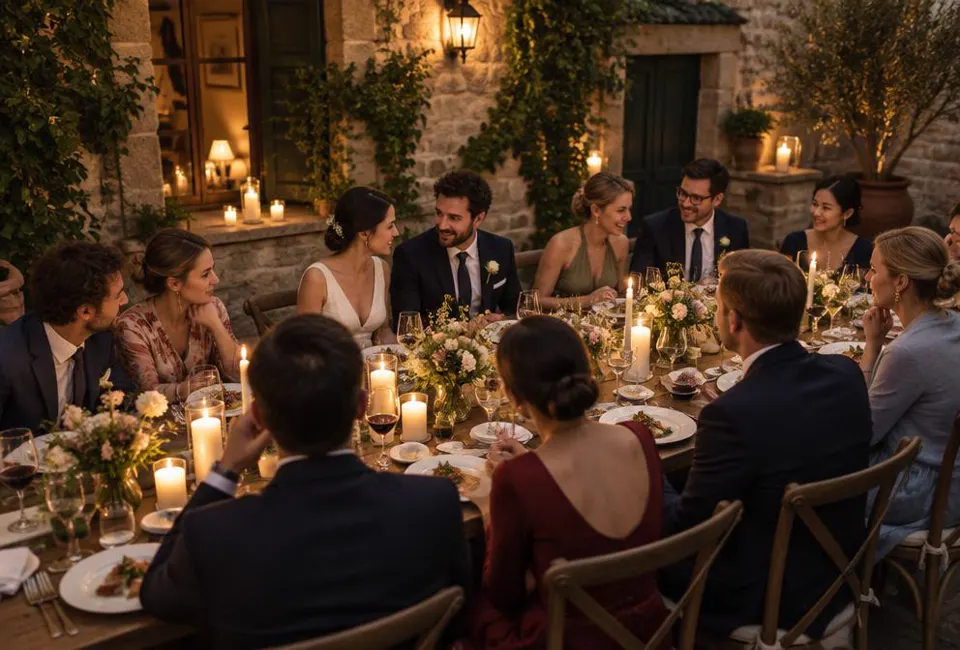
Defining Your Small Wedding Vision
Planning a small wedding requires a shift in mindset from traditional bulk planning to curated intentionality. This guide establishes your foundational vision by balancing emotional desires with practical guest count constraints.
The psychological foundation of a small wedding is built on the concept of intimacy over spectacle. While the average wedding costs approximately $33,000 in the US (The Knot Real Weddings Study 2025) and A$35,315 in Australia (Easy Weddings 2025), a smaller guest count allows you to redirect funds toward high quality experiences. For example, Elena and Marcus realized that by reducing their list from 150 to 40, they could afford a seven course tasting menu instead of a standard buffet. Defining your vision means deciding whether you want to save money or spend the same amount to provide a luxury experience for a few people.
The Rule of 50 for Guest Counts
To effectively understand how to plan a small wedding, you must apply the Rule of 50. This threshold is the dividing line between a traditional event and an intimate one. Once a guest list exceeds 50 people, the couple typically loses the ability to have a meaningful five minute conversation with every attendee. Logistically, 50 guests or fewer opens up non traditional venues like private dining rooms, art galleries, or small gardens. If your list is 51 or higher, you are entering the realm of standard event logistics which requires more formal coordination and infrastructure.
| Format Type | Guest Count | Key Characteristics | Primary Benefit |
|---|---|---|---|
| Elopement | 1 to 5 | Focus on the couple and legalities | Zero social pressure |
| Micro Wedding | 6 to 20 | Immediate family and closest friends only | Extreme budget flexibility |
| Intimate Wedding | 21 to 50 | Curated list with traditional elements | High quality guest interaction |
| Standard Small | 51 to 75 | Inclusive of extended family | Balance of tradition and scale |
When Sarah and Hiroshi began their process, they used a specific decision framework to choose their format. They asked themselves three questions: Do we want to host a dinner party or a dance party? Does the thought of a crowd cause us anxiety? Are we prioritizing our own experience or the expectations of our parents? By answering these, they moved away from a standard 100 person event toward a 15 person micro wedding. This decision allowed them to bypass the UK average wedding cost of £20,600 (Bridebook 2024) and instead invest in a private villa rental for a weekend.
A common mistake at this stage is trying to fit a large wedding vision into a small wedding budget or guest count. If you want a 20 person wedding but still desire a 10 piece live band and a 4 foot tall cake, the proportions will feel off. Instead, scale your elements to match the room. In Canada, where the average wedding is about C$30,000 (RBC), couples often find that a small wedding allows for a focus on artisanal details that would be too expensive at scale. Focus on the sensory experience: the scent of the flowers, the texture of the linens, and the quality of the acoustics.
Vision Alignment Checklist
- Confirm if the total guest count is under the 50 person threshold.
- Identify if the primary goal is cost savings or luxury per guest.
- Select the wedding format from the decision matrix.
- Draft a one sentence mission statement for the wedding day.
- List three non negotiable elements for the ceremony.
- Discuss potential family pushback regarding the smaller scale.
- Verify that the chosen format matches the couple's personality types.
- Determine the desired level of formality for the event.
Ultimately, your small wedding vision should be a reflection of your daily life. If you usually host quiet dinners, a micro wedding is a logical extension of your personality. Do not feel pressured to adopt grand traditions like a garter toss or a long receiving line if they do not fit the intimate atmosphere. By establishing these boundaries now, you prevent scope creep. This ensures that every subsequent planning decision, from the venue to the flowers, serves the goal of intimacy rather than just checking a box on a traditional wedding to do list.
Strategic Guest List Management
Mastering the guest list is the most critical hurdle in learning how to plan a small wedding without damaging long term relationships. This section provides a framework for selecting your inner circle while maintaining grace toward those who cannot be accommodated.
The core challenge of a small wedding is the mathematical reality of venue capacities and personal budgets. According to The Knot Real Weddings Study 2025, the average US wedding costs about $33,000, which often drives couples to seek more intimate settings. To manage expectations, you must first establish a hard cap based on your vision rather than external pressure. If you allow one exception for a distant relative, you set a precedent that makes it difficult to exclude others in that same social category. Consistency is your greatest defense against family conflict during the planning phase.
The Tiered Invitation Strategy
A tiered strategy categorizes guests by the depth of their current relationship to the couple. Tier one includes immediate family and daily life companions. Tier two consists of close friends and extended family members you see annually. Tier three covers professional acquaintances and distant relatives. By drawing a line clearly at the end of tier one or halfway through tier two, you create a logical boundary. This framework removes the emotion from the decision. Instead of deciding if you like a person enough to invite them, you are simply identifying which predefined category they occupy.
| Priority Level | Connection Type | Inclusion Rule | Example Guest |
|---|---|---|---|
| Tier 1 | Inner Circle | Automatic Invite | Parents and Siblings |
| Tier 2 | Active Friends | Space Permitting | Monthly Contact Friends |
| Tier 3 | Extended Network | Likely Exclude | Cousins or Coworkers |
| Tier 4 | Legacy Guests | Always Exclude | Parents' Friends |
Communication is vital when your guest list excludes people who expect an invitation. Consider Sarah and Mark, a couple who decided to limit their wedding to thirty people. When Sarah's aunt questioned why she was not invited, Sarah used a prepared script: We are so touched that you want to celebrate with us. Because we have chosen a very small venue for our ceremony, we are strictly limited to a guest list of thirty people. This means we are unable to invite our extended family members. We hope you understand that this was a difficult logistical decision, and we look forward to catching up with you soon.
The script works because it shifts the focus from the individual to the venue and the logistics. It is important for Sarah and Mark to remain firm and avoid apologizing excessively. Apologies can sometimes imply that a mistake was made, which invites the other person to offer solutions like paying for their own meal. By citing a specific number or a physical space limitation, the couple creates a boundary that cannot be negotiated. This approach preserves the dignity of the couple and the feelings of the uninvited guest by making the exclusion about the event structure.
Guest List Integrity Audit
- Have you spoken to this person in the last twelve months?
- Do you see this person at least once a year?
- Would you feel comfortable having a one on one dinner with them?
- Are you inviting them only because you attended their wedding?
- Does their presence align with your vision of an intimate day?
- Is this person a 'plus one' for someone you barely know?
- Are you including them to appease a parent or third party?
- Does the venue fire code permit this additional person?
Finally, remember that your guest list directly impacts your financial flexibility. As noted by Easy Weddings 2025, the average Australian wedding is A$35,315. In Canada, the average is C$30,000 according to RBC. Reducing your list by even ten people can free up 10 to 15 percent of your total budget. This capital can then be reinvested into higher quality catering or a more luxurious venue. Prioritizing the experience of twenty loved ones over the attendance of eighty acquaintances ensures that your investment creates lasting, meaningful memories for those who matter most in your daily life.
Budget Allocation for Intimacy
Effective financial planning for a smaller guest count requires a psychological shift from stretching funds to concentrating them on high impact elements. This section introduces a specialized framework to ensure your investment creates a premium experience rather than just a downsized traditional event.
When learning how to plan a small wedding, many couples mistakenly assume they will simply spend less across every category. Instead, the most successful intimate celebrations utilize the 80/20 Luxury Pivot. This framework dictates that you should allocate 80 percent of your total budget to the top 20 percent of guest touchpoints, such as food, beverage, and atmosphere. While a large wedding of 150 people requires a diluted budget to cover basic logistics, a small wedding allows you to reallocate the funds saved on rental chairs and mass produced invitations toward high quality upgrades like five course tasting menus or rare vintage pairings.
Global Benchmarks for Comparison
Understanding the global market helps place your intimate budget in context. In the US, the average wedding cost is about $33,000 according to The Knot Real Weddings Study 2025. In the UK, Bridebook 2024 reports an average of £20,600, while Easy Weddings 2025 notes the Australian average is A$35,315. In Canada, RBC estimates a cost of C$30,000. By choosing an intimate guest list, you are not necessarily aiming to spend less than these totals. Instead, you are choosing to spend that same $30,000 on 30 people rather than 150. This increases the spend per head from $200 to $1,000, fundamentally changing the quality of the event.
| Category | Traditional Allocation | Small Wedding Pivot | Resulting Impact |
|---|---|---|---|
| Catering | 30 percent (Buffet) | 50 percent (Chef Table) | Interactive dining experience |
| Stationery | 5 percent (Digital/Bulk) | 10 percent (Handmade) | Keepsake quality paper |
| Florals | 10 percent (Centerpieces) | 25 percent (Art Installation) | Immersive visual environment |
| Entertainment | 8 percent (Standard DJ) | 15 percent (Live Quartet) | Personalized acoustics |
Consider the scenario of Leo and Sarah. Instead of a standard ballroom, they hosted 20 guests at a private estate. By following the 80/20 Luxury Pivot, they avoided spending on guest shuttles or mass party favors. They instead hired a private chef to prepare a custom menu based on their favorite travel memories. Because their guest list was small, the cost for premium ingredients like truffles or aged steaks remained within their total budget. This focus on the sensory experience of their inner circle created a legacy event that felt far more expensive than the national averages cited by The Knot or RBC.
A common mistake in budget allocation for small weddings is failing to account for fixed costs. Even if you only have ten guests, you still pay the full price for a photographer, a wedding dress, and an officiant. These costs do not scale down with your guest count. To manage this, apply the formula: Total Budget minus Fixed Costs equals Variable Guest Fund. By maximizing the Variable Guest Fund, you ensure that every person present feels the weight of your hospitality. You are paying for depth of connection rather than the breadth of a crowd, which is the hallmark of intimacy.
80/20 Luxury Pivot Action Steps
- Calculate your total budget based on the local averages from The Knot, Bridebook, or Easy Weddings.
- Identify the top three elements that represent your relationship most authentically.
- Deduct fixed costs like attire and photography from your total pool.
- Allocate 80 percent of the remaining funds to your top three elements.
- Remove generic line items that do not enhance guest comfort.
- Source premium vendors who specialize in boutique or small scale service.
- Compare your per guest spend against the regional average to ensure a luxury ratio.
- Verify that your venue does not have a minimum guest count requirement that forces waste.
- Review the final allocation to ensure the guest experience is prioritized over logistics.
Finally, remember that transparency with vendors is vital when pivoting your budget. When contacting a florist, do not just ask for a small wedding price. Explain that you want to spend your full floral budget on one high impact installation rather than ten average centerpieces. This allows experts to utilize their skills for maximum creative effect. By being specific about where you want the luxury to sit, you guide your vendors to provide the highest value. This strategic approach ensures your wedding feels like a deliberate choice for intimacy rather than a budget restricted compromise.
Choosing Unconventional Venues
When you reduce your guest count, the architectural possibilities for your celebration expand beyond the traditional ballroom. Choosing an unconventional venue allows you to trade high capacity for high character, turning the physical space into a primary element of your wedding design.
Smaller guest lists unlock the gates to venues that simply cannot accommodate hundreds of people. For example, Elena and Marcus wanted a minimalist aesthetic for their thirty guests. They bypassed traditional hotels and instead rented a private art gallery loft. This choice allowed them to treat the evening like a sophisticated cocktail party rather than a formal banquet. Because the space was already curated with professional lighting and contemporary art, they spent nearly zero percent of their budget on floral arrangements or rentals. Private villas, historic libraries, and boutique restaurants offer similar benefits, providing built-in atmosphere that a standard hall lacks.
The primary advantage of these spaces is the intimacy they foster. In a boutique restaurant, you are not just a customer in a banquet room; you are often the sole occupants of the establishment. This allows for a deeper level of service and a focus on the culinary experience. While the US average wedding cost is about $33,000 (The Knot Real Weddings Study 2025), couples opting for smaller, non traditional spaces often reallocate their funds. Instead of paying for a large venue rental fee, they might spend that money on a ten course tasting menu or a curated wine pairing, elevating the quality of the event for their few attendees.
Vetting Spaces Without Standard Wedding Packages
Traditional venues operate on a plug and play model, providing tables, chairs, and catering. When you step into the world of private villas or industrial lofts, you become the primary coordinator of logistics. You must assess the infrastructure with a critical eye. A stunning cliffside villa might have a narrow staircase that makes food service difficult, or an old library might have strict noise ordinances that prevent a live band. It is essential to ask about power capacity for vendors and whether the existing furniture is available for use. If you must rent every fork and napkin, your budget may shift unexpectedly.
Unconventional Venue Infrastructure Audit
- Confirm the total electrical capacity for lighting and sound equipment to avoid blown fuses.
- Check for accessible restroom facilities suited for the guest count and elderly attendees.
- Verify if the venue requires a specific day of coordinator for outside vendors.
- Inquire about loading dock access or elevator dimensions for rental deliveries.
- Ask about noise restrictions and the exact time music must cease.
- Identify a designated staging area for catering teams to prep and plate food.
- Confirm the insurance requirements for hosting a private event on the property.
- Assess the lighting needs for evening transitions in spaces not built for events.
Consider the guest experience during the transition from ceremony to reception. In a gallery loft, you might need a creative way to flip the room while guests enjoy drinks. A common mistake is failing to account for the comfort of the group in a space that was not designed for long periods of sitting. If your chosen venue uses hard surfaces like concrete or stone, invest in soft rentals to improve acoustics and comfort. By prioritizing the flow of the evening, you ensure that the unique character of the venue enhances the celebration rather than complicating it.
Finally, lean into the existing personality of the space. If you are in a historic library, use the books as your backdrop. If you are in a garden, let the natural foliage dictate your color palette. How to plan a small wedding successfully often involves doing less, not more. By selecting a venue that speaks for itself, you reduce the need for external decor and create a more authentic, memorable environment for your guests. The goal is to make the location feel like an extension of your own home or personal style.
Designing the Guest Experience
When you learn how to plan a small wedding, the guest experience shifts from mass entertainment to high touch personalization. A limited head count allows you to redirect funds toward sensory details that would be cost prohibitive at a larger scale.
The hallmark of an intimate wedding is the depth of connection between the couple and their guests. With fewer people to host, you can transition from a generic reception to a bespoke evening tailored to specific interests. Consider the example of Elena and David, who decided their guest list of twenty five did not require a loud DJ or a traditional dance floor. Instead, they allocated their budget to a private chef for an eight course seasonal tasting menu. To facilitate deep connections, they placed curated conversation cards at each setting, featuring prompts related to shared history and future dreams, which transformed a standard dinner into an evening of storytelling and laughter.
Mastering the Art of Personalization
Personalization at a small wedding should feel intentional rather than decorative. Because you are not managing hundreds of attendees, you have the capacity to acknowledge each guest individually. One effective way to do this is through a structured welcome note placed at every seat. Use this three part formula for maximum impact: first, mention a specific memory you share with the guest. Second, express exactly why their presence was essential for this specific day. Finally, include a 'look out for' tip, such as a specific song or dish they will love. This transforms a simple piece of stationery into a cherished keepsake that reinforces the value of your relationship.
Small weddings also allow for a significant upgrade in quality. While the average US wedding costs about $33,000 (The Knot Real Weddings Study 2025) and UK weddings range from £20,600 (Bridebook 2024) to £23,000 (Which? 2024), a small guest list lets you spend a higher percentage of your budget on premium items. Instead of standard linens, you might choose hand loomed textiles. Instead of a basic open bar, you might offer a vertical wine tasting or a custom cocktail bar where a mixologist creates drinks based on each guest's personality. These choices elevate the day from a standard event to an immersive luxury experience for every person in the room.
| Category | Large Scale Standard | Intimate Scale Alternative | Impact Level |
|---|---|---|---|
| Dining | Buffet or Dual Plate | Multi-course Tasting Menu | High |
| Stationery | Standard Place Cards | Handwritten Personal Letters | Maximum |
| Music | Generalist Wedding DJ | Soloist or Specialized Trio | Moderate |
| Favors | Bulk Manufactured Items | Locally Sourced Curated Gifts | High |
| Seating | Large Rounds of Ten | Single Long Feasting Table | Maximum |
Finally, consider the logistical flow of the day to ensure guests never feel like an afterthought. In Canada, where the average wedding cost is about C$30,000 (RBC), or Australia, where the average is A$35,315 (Easy Weddings 2025), couples often find that smaller groups require less rigid structure. However, the lack of a traditional timeline can sometimes lead to stagnation. To avoid this, design 'micro moments' throughout the event. This could be a guided group toast where every guest shares one word to describe the couple, or a specialized dessert lounge where the group moves to a new setting for coffee and chocolates. These intentional shifts keep the energy high without needing a crowded dance floor.
Guest Experience Essentials
- Draft individual welcome notes using the memory formula.
- Select a single long table to foster communal dining.
- Choose three to five conversation prompts for table cards.
- Incorporate a sensory element like custom scents or textures.
- Plan a specific movement or room change to refresh the energy.
- Ensure every guest has a clear view and path to the couple.
- Assign a dedicated staff member for high touch table service.
- Review the menu for specific dietary preferences of each guest.
Navigating Social Etiquette and Boundaries
Successfully learning how to plan a small wedding requires balancing your personal boundaries with the expectations of friends and family. Navigating social etiquette ensures your intimate celebration remains joyful without leaving a trail of hurt feelings or misunderstood intentions.
When managing a restricted guest list, the Circle of Proximity framework serves as a vital decision tool. Start with the Inner Circle, which consists of immediate family and friends you speak with weekly. The Middle Circle includes active friends you have seen in the last six months. The Outer Circle contains extended relatives and casual acquaintances. To maintain consistency, couples like Sarah and Mateo might decide to stop at the Inner Circle only. This framework removes the guilt of exclusion by applying a logical rule. If you invite one cousin from the Outer Circle, etiquette suggests you must invite them all, so drawing a hard line at a specific circle is the most effective way to avoid social friction.
Managing Requests for Additional Guests
The most challenging aspect of an intimate wedding is declining plus one requests. Since every seat represents a significant percentage of your total capacity, honesty is the best policy. When a friend asks to bring a date, use a script that emphasizes the venue constraints. For example, tell them: We would love to meet your partner, but our venue has a strict capacity limit that we have already reached with our immediate family. We hope you understand that we are keeping things very small. This approach shifts the focus from a personal rejection to a logistical reality, making it harder for guests to take offense.
Scripts for Gracious Refusals
- For coworkers: We decided to keep our ceremony limited to family only, so we will not be inviting colleagues, but I would love to grab a celebratory drink with the team later.
- For extended family: We are hosting a micro wedding with only twenty guests. We wish we could have everyone there, but we are looking forward to catching up at the next family reunion.
- For friends asking for plus ones: Our guest list is capped at a very small number due to our specific venue choice. We are unable to accommodate extra guests, but we cannot wait to celebrate with you.
- For children: While we love your little ones, our wedding is an adults only event due to the size and nature of the space.
Social media requires a thoughtful strategy to prevent alienation. In a world where every moment is shared, seeing a live feed of a wedding they were not invited to can be painful for friends. Couples like Priya and Alex choose to delay posting photos until 48 hours after the event. When you do post, include a caption that acknowledges the intimacy of the day. Phrases such as 'We celebrated in a tiny, private ceremony' or 'We kept things very small' provide context to those scrolling. Avoid tagging the location or posting countdowns that might lead others to expect an invitation that is not coming.
Beyond digital etiquette, consider sending handwritten notes to those who did not make the final cut but are still important in your life. This proactive step validates the relationship without requiring an invitation. You might explain that while the wedding is small, their friendship remains a priority. This is particularly useful for long distance friends who might feel forgotten. By taking control of the narrative early, you prevent rumors and ensure your guests feel chosen rather than just included. Remember that a small wedding is defined by the quality of the interactions, not the quantity of the attendees.
Etiquette and Boundary Essentials
- Apply the Circle of Proximity framework to all potential guests.
- Address invitations to specific names only to discourage plus ones.
- Draft a standard response for guests who ask for exceptions.
- Decide on a social media blackout period for the wedding day.
- Communicate the small scale of the event early in the process.
- Verify that your close family understands the restricted guest list rules.
- Send thank you notes to those who sent gifts despite not being invited.
- Keep the wedding website password protected to maintain privacy.
- Ensure the tone of all refusals is warm, firm, and consistent.
Logistics of a Shorter Timeline
Learning how to plan a small wedding on a condensed timeline requires a shift from traditional long lead sequences to decisive, rapid actions. When the guest count is low, you gain the agility to secure premium dates and niche vendors that would be unavailable for larger crowds.
The primary advantage of a small wedding is the ability to bypass the standard twelve month engagement cycle. While the US average cost for weddings is about $33,000 according to The Knot Real Weddings Study 2025, shorter timelines often allow couples to utilize mid week dates or off peak seasons to maximize their budget. For a six month window, the first thirty days are critical. You must secure the venue and the celebrant immediately. Unlike large events that require massive catering infrastructures, small weddings can leverage private dining rooms in top tier restaurants which often have shorter booking lead times than dedicated banquet halls.
The Four Month Planning Sprint
| Timeline | Action Item | Priority Level |
|---|---|---|
| Month 1 | Venue and legal paperwork | Critical |
| Month 2 | Photography and attire | High |
| Month 3 | Menu selection and invites | Moderate |
| Month 4 | Final fittings and floral | Operational |
Consider the case of Sarah and Mateo, who decided to wed in just three months. They focused their energy on a high end bistro that handled all tablescapes and food, eliminating the need for five separate rental vendors. By choosing an off the rack suit and a sample sale dress, they avoided the six month lead time required for custom garments. Their strategy was simple: they prioritized the guest experience over complex logistics. This meant they could spend more time curating a personalized playlist rather than coordinating a fleet of shuttle buses for a hundred people.
Managing DIY elements requires a strict boundary to avoid pre wedding burnout. When you are planning in under six months, every hour spent hot glueing place cards is an hour lost to final coordination. Limit yourself to two specific creative projects. If you choose to design your own stationery, use a digital printing service to handle the physical production. According to Easy Weddings 2025, an Australian wedding costs about A$35,315, and a portion of that budget often covers professional labor that saves you dozens of hours of stress. Evaluate your hourly worth before committing to manual labor.
Short Timeline Essentials
- Verify legal notice periods for your specific region immediately.
- Purchase off the rack or sample sale attire to avoid shipping delays.
- Send digital Save the Dates within one week of securing the venue.
- Limit custom decor to one or two high impact areas.
- Use a single point of contact for catering and rentals.
- Confirm hair and makeup trials at the time of booking.
- Set a firm deadline for DIY projects 14 days before the event.
Finalizing details in the last month is about confirmation rather than creation. Ensure all vendors have a simplified floor plan and a precise timeline. Because the wedding is small, communication should be direct. Use a shared digital folder for all contracts and receipts. If you are in Canada, where a wedding averages about C$30,000 according to RBC, or the UK where Bridebook 2024 notes costs around £20,600, your smaller guest count allows you to pivot quickly if a vendor becomes unavailable. Maintain a list of two backup options for your most essential services just in case.
Common Small Wedding Mistakes to Avoid
The final phase of learning how to plan a small wedding involves recognizing that fewer guests do not automatically simplify the logistical burden. Avoiding common pitfalls ensures your intimate celebration remains stress-free and avoids the trap of underestimated complexity.
One of the most frequent errors couples make is underestimating the logistical needs of a smaller group. Even with twenty guests, you still require a legal officiant, a reliable catering team, and a photographer. While the UK average wedding cost sits around £20,600 according to Bridebook 2024, or up to £23,000 per Which? 2024 data, a small wedding does not scale down linearly in effort. Consider Sarah and Liam, who hosted thirty guests in a remote forest clearing. They assumed a coordinator was unnecessary but found themselves directing the shuttle driver and lighting candles while they should have been getting dressed. A day-of coordinator is vital for managing vendors so you can focus on the intimacy of the moment.
Spatial Planning and Vendor Assumptions
Overstuffing a small room is a mistake that ruins the atmosphere of an intimate gathering. Couples often choose a tiny venue to save money, but forgetting to account for the space required for a buffet table or a musician can make the room feel cramped rather than cozy. In Canada, where the average wedding cost is about C$30,000 according to RBC, spending a higher percentage of the budget on a slightly larger space for comfort is a wise trade-off. Ensure there is enough square footage for guests to move their chairs back and walk to the restroom without disturbing the entire party. A cramped room creates social friction rather than connection.
| Planning Category | Large Wedding Impact | Small Wedding Impact |
|---|---|---|
| Vendor Communication | High volume, lower detail per guest. | High detail, custom requests for all. |
| Venue Layout | Structured, fixed seating charts. | Flexible, requires careful spatial flow. |
| Guest Interaction | Brief greetings in a receiving line. | Longer, deep conversations with all. |
| Day-of Coordination | Essential for crowd control. | Essential for vendor and flow management. |
Another error involves failing to provide clear direction to guests. Small weddings often utilize unconventional venues like art galleries or private villas. In Australia, where the average wedding cost is A$35,315 according to Easy Weddings 2025, couples might opt for a destination coast house. If you do not provide a detailed itinerary, guests might feel lost in a non-traditional setting. Use a script for your invitations such as: We invite you to an intimate dinner where we will exchange vows at sunset, followed by a communal feast. This sets expectations for the flow of the evening and prevents confusion regarding the lack of a traditional five-hour dance floor.
Finally, avoid the temptation to over-DIY every element. Because the guest count is low, many couples believe they can hand-make every favor, centerpiece, and dessert. This often leads to burnout forty-eight hours before the ceremony. Even if the US average wedding cost is about $33,000 per The Knot Real Weddings Study 2025, your time remains your most valuable currency. Focus your DIY efforts on one high-impact area, such as handwritten letters for every guest, and hire professionals for the rest. This ensures the quality matches the importance of the occasion and prevents you from being exhausted when you finally walk down the aisle.
Critical Mistakes to Double-Check
- Failing to hire a professional photographer despite the small group size.
- Choosing a venue that is too small for basic guest movement.
- Omitting a day-of coordinator and self-managing vendors.
- Overlooking the need for a weather backup plan for outdoor sites.
- Neglecting to tell guests about unconventional seating or meal styles.
- Assuming a small guest list means no sound system is needed.
- Underestimating the time needed for setup and strike.
- Failing to provide transportation for remote or difficult venues.
- Choosing too many DIY projects that consume your final week.