Navigating Financial Contributions and Expectations
Organizing a wedding with divorced parents begins with a transparent financial strategy that respects the complexities of modern family structures across the globe. This foundation ensures that funding discussions lead to celebration rather than conflict.
Planning a wedding with divorced parents requires a shift from traditional etiquette toward a modern model of shared responsibility. Financial dynamics vary significantly by region. For instance, the US average wedding cost is about $33,000 according to The Knot Real Weddings Study 2025. In the UK, costs range from £20,600 as reported by Bridebook 2024 to £23,000 according to Which? 2024. Australian couples face an average of A$35,315 per Easy Weddings 2025, while Canadian celebrations average C$30,000 according to RBC. Understanding these benchmarks helps couples set realistic expectations when approaching multiple households for contributions, ensuring no party feels unfairly burdened.
Applying the Cost Distribution Formula
To remove emotion from the initial budget conversation, use the Cost Distribution Formula: (Total Budget / Number of Contributing Parties). This creates a baseline for discussion. Consider a scenario where Maya and Liam are planning a wedding. Maya has two sets of remarried parents, and Liam has one set of married parents. If they apply this formula, they divide their total target budget by four potential contributors: Maya's mother, Maya's father, Liam's parents, and the couple themselves. This calculation provides a neutral starting point for private conversations with each household about what they feel comfortable committing.
| Contribution Model | Source of Funds | Decision Power | Potential Risks |
|---|---|---|---|
| Equal Split | Four Households | Balanced/Couple Led | Communication fatigue |
| Primary Funder | One Parent (75% plus) | High Parent Influence | Loss of couple vision |
| Self Funded | Couple (100%) | Total Autonomy | Higher financial stress |
| Specific Item | Assigned Vendors | Vendor Specific | Inconsistent quality |
| Tiered Split | Income Based | Shared Decision | Feelings of inequality |
Maintaining autonomy is crucial when one parent contributes a higher percentage. A common mistake is allowing the largest check writer to dictate the guest list or venue. To prevent this, Sarah and David established a 10 percent rule. They agreed that while parents could offer input, the final decision on any vendor rested with the couple as long as it stayed within the allocated budget. If a parent offers 60 percent of the total cost, the couple should explicitly state: We are so grateful for this gift. We want to ensure you are honored, but we will be making the final creative decisions for the day.
Effective communication requires individual meetings rather than group chats. A couple should speak to each parent privately to discuss the Cost Distribution Formula. A sample script for this interaction is: We are starting our planning and want to be transparent about our budget. We are looking at a total cost of X and are dividing it among ourselves and both families. Is there a specific amount or a particular wedding element you would like to contribute toward? This approach prevents parents from feeling compared to their former partners and allows for honest discussions about their personal financial boundaries.
Financial Planning Checklist for Split Households
- Calculate the total budget using local averages as a guide.
- Identify all potential contributing parties including stepparents.
- Hold private one on one meetings with each set of parents.
- Document all promised amounts in a shared spreadsheet.
- Clearly define which decisions the couple will retain sole control over.
- Establish a neutral bank account for all wedding deposits.
- Set a deadline for when funds need to be transferred.
- Discuss how to handle unexpected overages or hidden costs.
- Draft a thank you plan to acknowledge each contribution individually.
First Steps: The Announcement and Strategy Meeting
The initial announcement of an engagement sets the emotional tone for the entire planning process, especially when managing a wedding with divorced parents. Establishing a strategy early prevents power struggles and ensures that the focus remains on the couple rather than old grievances.
When announcing your engagement, prioritize speed and sequence to avoid the feeling of competition. A common mistake is a group text or a public social media post before speaking to each parent individually. Sarah and Leo, for instance, chose to call Sarah's mother first on a Tuesday, followed by her father on Wednesday. By staggering these conversations within a 24-hour window, you minimize the risk of one parent hearing the news through the grapevine. This approach acknowledges their individual importance in your life while maintaining a controlled flow of information that prevents either party from feeling like a secondary thought.
Implementing the Neutral Ground Rule
For the first strategy meeting regarding wedding logistics, adopt the Neutral Ground Rule. This means holding discussions in public spaces like a quiet cafe or a park rather than a family home. Public settings naturally encourage more restrained behavior and prevent the 'home field advantage' that can occur if one parent feels they have more authority in their own space. If your parents are high conflict, do not attempt a joint meeting yet. Conduct separate strategy sessions where you clearly outline your vision, focusing on the future celebration rather than rehashing past marital issues or financial disagreements from years prior.
Strategy Meeting Objectives
- Confirm the approximate date range and desired location style.
- Assess their desire to be involved in specific planning committees.
- Clearly state that both biological parents will have significant roles.
- Establish a communication preference, such as a dedicated email thread.
- Identify potential 'trigger' topics to avoid during early planning.
- Set a boundary regarding the inclusion of new partners or spouses.
Handling high conflict parents requires a firm script that centers on your happiness. If one parent expresses discomfort about the other's involvement, you must be direct. You might say: 'We are so excited to celebrate this milestone with you. Because both of you are our parents, you will both be fully involved in the festivities and the planning process. We are not asking you to reconcile, but we are asking you to put our wedding day above any past differences. We need to know now if you can commit to supporting us peacefully so we can move forward with the planning together.'
| Relationship Status | Announcement Method | Strategy Meeting Format | Primary Goal |
|---|---|---|---|
| Collaborative | Joint dinner or call | Single group meeting | Unity and shared joy |
| Parallel Parenting | Back-to-back phone calls | Separate 1-on-1 coffee | Information consistency |
| High Conflict | Individual private visits | Strict digital updates | Boundary enforcement |
| Estranged | Formal letter or email | Mediation via third party | Safety and predictability |
The strategy meeting is also the time to mention general budget expectations without asking for money directly. In Australia, the average wedding costs about A$35,315 according to Easy Weddings 2025. In the UK, Bridebook 2024 reports costs around £20,600. Providing these benchmarks helps parents understand the current economic landscape of weddings. If a parent attempts to use their potential financial contribution as a lever to exclude the other parent, refer back to your script. Remind them that your priority is a peaceful environment for all guests, and that their emotional support is more valuable than any specific dollar amount or currency.
Pre-Announcement Preparation Checklist
- Decide who will be told first based on emotional sensitivity.
- Prepare a 30 second elevator pitch of your wedding vision.
- Research local cafe locations for neutral ground meetings.
- Draft a basic timeline to share with both parties.
- Discuss with your partner how to handle negative reactions.
- Confirm that your partner is ready to back up your boundaries.
- Review the guest list for any immediate 'red flag' relatives.
- Set a 'no wedding talk' window for after the announcements.
Invitation Wording for Complex Family Trees
Crafting the perfect invitation wording for a wedding with divorced parents requires a balance of formal etiquette and modern sensitivity to ensure every guardian feels respected.
The foundational guideline for invitation etiquette is the Host First rule. Traditionally, the individual or couple paying for the event is listed at the top of the card. With the average cost of weddings reaching approximately 33,000 dollars in the US (The Knot Real Weddings Study 2025) and 35,315 dollars in Australia (Easy Weddings 2025), modern couples often find that multiple parties contribute to the total. When both sets of divorced parents contribute equally, the most diplomatic approach is to list names alphabetically by surname. This removes the perception of hierarchy and acknowledges all parents as co hosts of the celebration without favoring one household over the other.
Templates for Remarried and Deceased Parents
When a parent has remarried and the stepparent is involved in the hosting duties, names should be grouped by household. For example, if Sarah’s mother and stepfather are hosting alongside her father, the invitation might read: Mr. and Mrs. Michael Thompson and Mr. David Miller request the honor of your presence at the marriage of their daughter Sarah Miller. If a parent is deceased, they cannot technically host. In this scenario, couples like Leo and Maya might choose to phrase the invitation as: Maya Williams, daughter of Mrs. Diane Williams and the late Mr. Robert Williams, and Leo Chen, son of Mr. and Mrs. Arthur Chen.
| Scenario | Primary Phrasing | Key Etiquette Rule |
|---|---|---|
| Divorced, Both Hosting | Mrs. Elena Ross and Mr. Julian Ross | Use separate lines for each name. |
| Remarried, Mother Hosting | Mr. and Mrs. Steven Grant | Stepfather is included as a host. |
| All Parents Contributing | Together with their families | Best for complex or equal funding. |
| One Parent Deceased | Ms. Jane Doe and the late John Doe | Honors memory without host status. |
| Stepparent Not Hosting | Mrs. Linda Smith and Mr. Paul Jones | List biological parents on separate lines. |
A common mistake occurs when couples use the word and to join names that are not currently married. In formal wedding stationery, the word and is reserved for legally married couples. If divorced parents like Mark and Elena are hosting together but are no longer married, their names must appear on separate lines without a joining conjunction. This subtle distinction prevents confusion for guests and respects the current marital status of both parties. If the list of names becomes too long, spanning more than four lines, switching to the inclusive Together with their families phrasing is often the most elegant solution for the layout.
Invitation Drafting Workflow
- Confirm the specific legal names and preferred titles for all parents and stepparents.
- Identify the primary financial contributors to determine the hosting order.
- Check that unmarried or divorced parents are listed on separate lines.
- Verify that deceased parents are mentioned as late to honor their memory.
- Verify alphabetical order if two sets of parents are contributing equal funds.
- Proofread to ensure the word and only appears between currently married couples.
- Send a digital draft to all biological parents to verify spelling before printing.
- Ensure the bride or groom's name follows the corresponding parent's name clearly.
Clarity is the ultimate goal when navigating complex family trees on paper. If a couple is paying for the wedding themselves, which is common in Canada where costs average 30,000 dollars (RBC), they may choose to omit parent names entirely to avoid drama. However, if a parent feels strongly about their name appearing, couples can use the phrasing Together with their families, Sarah Miller and James Taylor request the pleasure of your company. This recognizes the support of the family unit without dissecting individual contributions or marital histories, ensuring the focus remains on the unity of the new couple.
The Ceremony: Seating Charts and Walking Down the Aisle
The ceremony is the moment where family dynamics are most visible, requiring a strategic approach to seating and the processional to honor every relationship without causing friction. Navigating a wedding with divorced parents demands a plan that balances tradition with the reality of current family ties.
Implementing the Three Row Seating Strategy
To minimize tension when parents do not get along or have new partners, the three row method is the gold standard for global ceremonies. In the first row, place the parent who primarily raised the bride or groom along with their current spouse. The second row is reserved for the other biological parent and their partner. The third row houses grandparents or close extended family members. This physical distance prevents forced interactions during the exchange of vows. Consider Sarah and Liam's wedding where Sarah's mother and stepfather sat in row one, while her father and his new wife took row two, allowing both parties to feel honored without sharing a singular armrest.
| Scenario | Row 1 Placement | Row 2 Placement | Row 3 Placement | |
|---|---|---|---|---|
| Friendly Divorce | Both biological parents | Stepparents and siblings | Grandparents | Aunts and uncles |
| High Tension | Mother and her partner | Father and his partner | Extended family | Close friends |
| Single Active Parent | Primary parent and spouse | Second parent (if present) | Siblings | Grandparents |
| Stepparent Influence | Biological parent A | Biological parent B | Stepparents | Family friends |
When assigning seats, use formal place cards even for the ceremony. This removes the awkwardness of guests wondering where to sit as they walk down the aisle. If a parent is contributing significantly to the budget, which averages about $33,000 in the US according to The Knot Real Weddings Study 2025, they might feel entitled to the front row. However, the couple should prioritize emotional comfort and peace over financial leverage. Communicating these seating arrangements two weeks before the wedding prevents day of surprises or verbal disputes in front of the altar. Clarity is the most effective tool for maintaining decorum.
The Processional: A Decision Framework
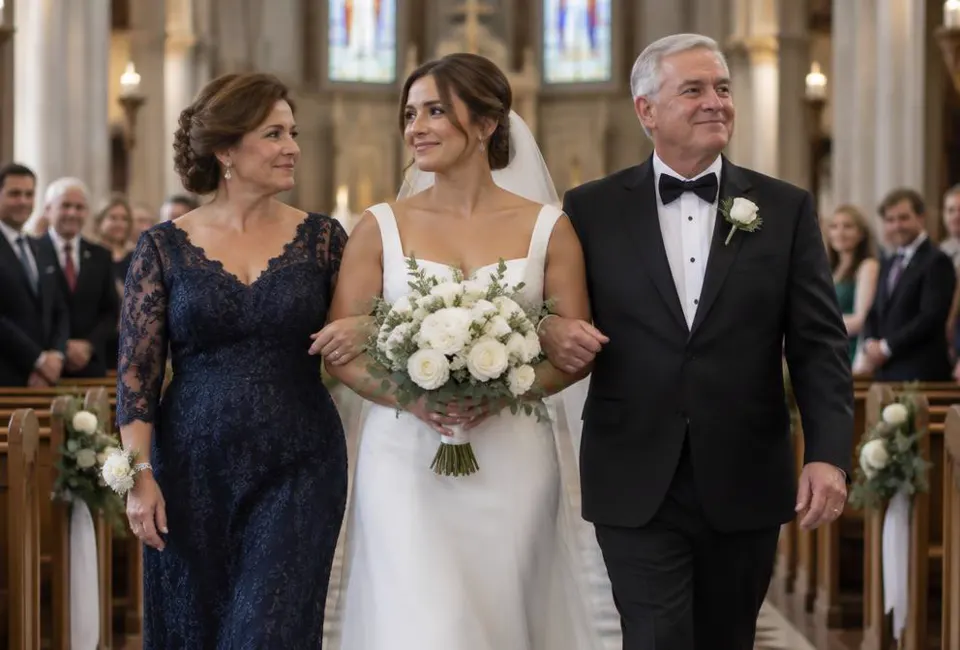
The walk down the aisle is a symbolic transition that often triggers anxiety in a wedding with divorced parents. To decide on your processional, first ask if both parents can stand within five feet of each other without conflict. If the answer is yes, a dual escort is a beautiful way to honor both. If the answer is no, evaluate who has been the most consistent emotional support. Walking with one parent is perfectly acceptable. For those facing extreme conflict between parents, walking solo or with a partner is a modern choice that eliminates the need to choose sides entirely. This prevents any one parent from feeling excluded by the other's presence.
Aisle Logic: Evaluating Your Options
- Assess if both parents can walk together peacefully.
- Determine if a stepparent should be included in the walk.
- Consider walking halfway with one parent and halfway with another.
- Verify the aisle width can accommodate three people if walking with both.
- Decide if the groom will also be escorted by his parents.
- Script a clear explanation for parents who are not walking you.
- Confirm the music length matches the slower pace of a grouped processional.
- Plan the hand off at the altar to avoid awkward pauses.
Common mistakes include trying to force a reconciliation during the processional. If Marcus decided to have his estranged father and his mother walk him down the aisle despite years of silence, the resulting tension would be palpable to every guest. Instead, Marcus could have his mother walk him to the front while his father is seated beforehand with honor. Another error is neglecting to inform the officiant of the plan. The officiant needs to know who is being handed off to whom so they can adjust their opening remarks and avoid asking 'Who gives this woman away?' if that phrasing creates discomfort for the family.
Ultimately, the ceremony should reflect the couple's current reality rather than an idealized past. By utilizing the three row seating method and a logical processional choice, the focus remains on the union rather than the divorce. Whether you choose to walk solo or have both parents by your side, the key is consistency and early communication. Ensure every party feels seen and respected within the boundaries you have established. This strategic planning ensures that the ceremony is a moment of celebration rather than a source of stress for the couple and their guests alike.
Managing the Photography Shot List
Managing the photography shot list is a critical tactical operation that prevents family tension from overshadowing the visual record of the wedding day. By implementing a Buffer Zone, couples can facilitate all necessary group portraits while maintaining a peaceful environment for every participant.
The photography Buffer Zone is a scheduled ten to fifteen minute period between formal family groupings that allows one set of parents to exit the portrait area before the next arrives. This intentional gap eliminates the possibility of awkward waiting periods where estranged parents might feel forced to interact. When planning a wedding with divorced parents, this timeline becomes your most effective tool for emotional regulation. The goal is to ensure that the couple remains the focus, rather than the logistics of who is standing where. A well executed buffer ensures that everyone feels honored without the pressure of forced proximity.
Consider the scenario of Maya and James, who faced a complex situation with Maya's parents, who had not spoken in five years. To manage the portraits, they utilized a timed rotation strategy. They scheduled Maya's mother and her partner for the first twenty minutes, followed by a ten minute buffer where the bridal party took group shots. Only after this transition did Maya's father and his spouse arrive for their dedicated session. This rotation allowed both parents to receive formal, high quality portraits with the couple without ever having to stand next to one another or share a physical space during the process.
The Timed Rotation Framework
| Time Slot | Group Description | Action Required | Parent Location |
|---|---|---|---|
| 00:00 to 00:15 | Parent A + Spouse | Formal Portraits | Arrival at Photo Site |
| 00:15 to 00:25 | Buffer Zone | Bridal Party Shots | Parent A Departs Area |
| 00:25 to 00:40 | Parent B + Spouse | Formal Portraits | Arrival at Photo Site |
| 00:40 to 00:50 | Buffer Zone | Couple Portraits | Parent B Departs Area |
| 00:50 to 01:00 | Combined Siblings | Sibling Portraits | Parents at Cocktail Hour |
A common mistake is assuming the photographer will naturally manage these family dynamics. Professional photographers are experts in lighting and composition, but they are not mediators. It is the responsibility of the couple to provide a specific, named list of every individual required for each shot. Avoid using generic terms like 'the bride's family' because this can lead to confusion regarding stepparents or long term partners. Clear labels such as 'Group 1: Bride, Mother, Stepfather' and 'Group 2: Bride, Father' provide the photographer with a roadmap that avoids accidental or forced combinations that could cause distress.
Cost also plays a role in how you structure your time. According to The Knot Real Weddings Study 2025, the US average wedding cost is about $33,000, and a significant portion of that goes toward professional media. In Australia, where the average is about A$35,315 according to Easy Weddings 2025, maximizing your photographer's time is essential. By using a Buffer Zone, you ensure that you are paying for actual photography rather than paying for a professional to stand by while family members navigate an argument or refuse to stand in the correct position. Efficiency in the shot list protects your investment and your peace of mind.
Photography Preparation Checklist
- Create a master list of all required family groupings using full names.
- Assign a trusted friend to act as a 'wrangler' to usher people in and out.
- Share the final timed rotation with both parents one week before the wedding.
- Confirm the 'no stand next to' list with your photographer in writing.
- Ensure the photographer has a list of 'safe' conversational topics.
- Designate separate waiting areas for parents if the venue allows it.
- Plan for at least two 10 minute buffer periods during family formals.
- Verify that all stepparents know their specific arrival times for photos.
- Review the shot list for any accidental omissions of new partners.
Finally, remember that the photography session sets the tone for the rest of the event. If the portraits are rushed or filled with tension, that energy can carry into the reception. By prioritizing a structured rotation and providing clear scripts to your vendors, you create a controlled environment where every parent feels respected. This strategy shifts the focus from managing conflict to celebrating the union. When the wedding with divorced parents is handled with this level of detail, the resulting photos reflect joy and connection rather than the underlying stress of family politics.
Reception Flow: Tables, Speeches, and Dances
Successfully managing a wedding with divorced parents requires a reception strategy that prioritizes social comfort while honoring every parental figure. By rethinking traditional floor plans and timelines, couples can prevent tension and ensure every host feels respected without forcing unnatural proximity.
The Satellite Table Layout Strategy
Traditional weddings often feature a single head table for the family, but this creates significant friction for divorced parents. The Satellite Table layout is a modern solution where each parent or set of parents hosts their own table in a separate area of the room. Instead of one VIP zone, the couple creates multiple hubs of honor. For example, Elena and Marcus placed her mother's table near the dance floor and her father's table near the garden view. This allowed each parent to be the center of their own social circle, surrounded by their respective siblings and close friends, eliminating the awkwardness of shared salt shakers and forced small talk.
When implementing satellite tables, proximity to the couple is the main currency of status. If the parents are not on speaking terms, ensure the tables are equidistant from the sweetheart table but positioned so the parents are not in each other's direct line of sight. Avoid placing one parent at the front and the other in the back, as this publicly signals a hierarchy of importance. Each table should be styled identically with the same floral arrangements and wine service to ensure no one feels slighted. This framework focuses on hospitality rather than high school cafeteria politics, allowing parents to relax and enjoy their host roles.
Logistics for Toasts and Parent Child Dances
The order of speeches often causes anxiety in a wedding with divorced parents. A neutral approach is to follow chronological order or a logic based on the couple's relationship. Consider a script where the mother of the bride welcomes guests during the first course, followed by the father of the bride before the main meal. If a stepparent is also speaking, they should ideally be introduced by their spouse to clarify their role. For example, David's father could introduce his stepmother by saying, Sarah has been a dedicated part of David's journey for ten years and would like to share a few words. This validates the stepparent without overshadowing the biological parent.
Parent child dances require similar tactical planning when stepparents are involved. If a bride wants to dance with both her father and stepfather, the smoothest method is a song split. The bride dances the first two minutes with her father, then the DJ invites the stepfather to the floor for the final ninety seconds. This prevents the need for two full songs, which can drag the reception momentum down. Alternatively, if the relationship with a biological parent is strained, some couples choose to have a joint dance where both parents dance with different partners simultaneously, taking the spotlight off the specific parental dynamic and focusing on the celebration.
| Scenario | Table Layout | Speech Order | Dance Solution |
|---|---|---|---|
| High Tension | Opposite sides of room | Pre-recorded or absent | No formal parent dance |
| Cordial/Polite | Separate but adjacent | Birth parent followed by step | Split song: 2 mins each |
| Single Parent Host | One head table | Single host speech | Full song with host |
| Blended Harmony | One large shared table | Joint toast by both parents | Back to back full songs |
Reception Logistics Checklist
- Confirm total number of satellite tables required for each parental unit.
- Verify that all parent tables have identical centerpiece heights and floral quality.
- Provide the DJ or MC with a phonetic pronunciation guide for all parents and stepparents.
- Set a strict three minute time limit for each parental toast to maintain flow.
- Discuss the song transition points with the band or DJ for split dances.
- Ensure the photographer knows which parents should not be framed in the same wide shot.
- Brief the venue coordinator on the seating chart to prevent accidental merging of groups.
- Identify a neutral family member to act as a point of contact for each table.
- Clarify who will be introduced during the grand entrance to avoid excluding stepparents.
Communication is the final piece of the reception puzzle. Inform each parent of the plan two weeks before the event. You might say: Dad, we have set up a special table for you and your family near the stage so you have a great view of the band. I will be dancing with you first, and then I will have a short dance with Mark to honor his role too. Setting these expectations early prevents day of surprises and allows parents to process their emotions privately. By focusing on the guest experience and clear transitions, the couple can navigate these complexities with grace and ensure the reception remains a celebration of their new union.
Conflict Resolution and Boundary Setting Scripts
Navigating a wedding with divorced parents requires a shift from emotional reactivity to firm, pre-scripted communication that prioritizes the couple's peace over historic family grievances.
When planning a wedding with divorced parents, the Gray Rock method serves as a vital psychological tool. This technique involves becoming as uninteresting and non-responsive as a gray rock during heated moments. By providing short, non-committal answers to prying questions or criticisms, you starve the conflict of the emotional oxygen it needs to survive. For example, if a parent criticizes a decision made by their ex-spouse regarding the rehearsal dinner, the couple should respond with phrases like, 'I hear your concern, but the plan is finalized.' This prevents the escalation of drama and keeps the focus entirely on the logistics of the event rather than past marital trauma.
Scripts for Navigating Parental Ultimatums
The most challenging scenario involves a parent threatening to boycott the wedding if the other parent or a specific stepparent is present. Consider the case of Sarah and Liam. When Sarah's father stated he would not attend if his ex-wife's new husband was at the head table, Sarah used a 'boundary-first' script. She said, 'Dad, we love you and want you there, but our guest list is not up for negotiation. We would be heartbroken if you chose not to come, but we will respect your decision if you feel you cannot attend.' This approach places the responsibility for attendance squarely on the parent while maintaining a kind but unyielding stance.
Effective Phrases for Boundary Setting
- We are not discussing the guest list today. Let us focus on the floral arrangements.
- I understand you have strong feelings, but this is the decision we have made for our wedding day.
- It is important to us that both of our parents are present. We hope you can put differences aside for five hours.
- We are not willing to act as a messenger between you two. Please communicate directly regarding logistics.
- That topic is off-limits for wedding planning sessions. Let us move on to the next item.
If a parent attempts to use their financial contribution as leverage for control, the script must remain professional. In a scenario where a mother threatens to withdraw funding for the catering, the couple might say, 'We appreciate your generous gift, but if it comes with strings that dictate our guest list or bridal party, we will need to decline the funds and scale back our plans.' This prevents the wedding from becoming a transactional battleground. By being prepared to walk away from the money, the couple retains full creative and emotional control over their celebration.
| Scenario | The Trigger | The Formulaic Response |
|---|---|---|
| The Ultimatum | Parent refuses to attend if ex is present. | Express love + State the boundary + Acceptance of their choice. |
| The Vague Critique | Parent insults the other's taste or budget. | Acknowledge the comment + Pivot to a neutral topic. |
| Financial Coercion | Parent uses money to force a change. | Express gratitude + Reiterate the vision + Offer to decline funds. |
| The Gatekeeper | Parent demands to see the guest list for veto power. | State the decision process + Confirm the list is final. |
Consistency is the final key to these scripts. If one parent sees the couple bending a rule for the other, the boundary system collapses. Couples must present a united front, ensuring that every script used is agreed upon by both partners beforehand. By documenting these boundaries early, you reduce the likelihood of last-minute outbursts. The goal is not to fix the family dynamic, but to create a temporary, respectful environment that allows the wedding to proceed with dignity and joy for everyone involved.
The Stepparent Inclusion Framework
Successfully managing a wedding with divorced parents requires a delicate balance between honoring long term biological bonds and acknowledging the significant roles played by supportive stepparents. The Stepparent Inclusion Framework provides a structured approach to ensure every parental figure feels valued without triggering historical sensitivities or competitive dynamics.
The primary challenge in modern wedding planning is recognizing stepparents as integral family members while maintaining the primary status of biological parents. The most effective strategy involves utilizing subtle cues rather than grand gestures. For example, a bride might choose a specific flower for her stepfather's boutonniere that matches the bridal bouquet, while the biological father wears one that matches the groom. This creates a visual connection between the bride and her stepfather that is distinct yet separate from the formal parental role. These small distinctions prevent biological parents from feeling replaced while ensuring stepparents do not feel like mere guests.
Layered Recognition and Pre-Wedding Events
Consider the case of a couple, Sarah and David, who wanted to honor David's stepmother who raised him. Instead of a public speech that might upset his biological mother, they hosted an intimate family lunch two days before the wedding specifically for stepparents and siblings. During this meal, they presented his stepmother with a personalized handkerchief. This private acknowledgment allowed for genuine emotion without the pressure of a public stage. In the wedding program, they listed biological parents first, followed by a section titled With Heartfelt Thanks to Our Families, which listed stepparents by name. This hierarchy respects tradition while validating modern family structures.
| Inclusion Category | Subtle Approach | Overt Approach | Risk Factor |
|---|---|---|---|
| Floral Decor | Matching pocket square | Custom boutonniere | Bio-parent jealousy |
| Processional | Seated in second row | Escorting the groom | Visual imbalance |
| Programs | Grouped thank you note | Individual name credit | Cluttered layout |
| Reception | Reserved table seating | Special toast mention | Speech length fatigue |
| Pre-Wedding | Thank you card at dinner | Stepparent-only brunch | Scheduling conflicts |
Communication scripts are vital when explaining these decisions to all parties. If a biological parent expresses concern about a stepparent's role, use a collaborative script: We are so grateful for your role as my parent. We also want to recognize the support John has provided over the last ten years in a way that feels respectful to everyone. We have decided to include him in the program and give him a special boutonniere, while you will be the one walking me down the aisle. This reinforces the biological parent's unique status while setting a firm boundary regarding the stepparent's inclusion. Consistency across both sides of the family is also crucial for maintaining peace.
Stepparent Inclusion Action Plan
- Review the guest list to ensure stepparents are seated with their respective spouses.
- Order unique boutonnieres or corsages for stepparents that differ from biological parents.
- Draft the wedding program to include stepparent names in a dedicated gratitude section.
- Schedule a private moment or small gift presentation for stepparents during the rehearsal.
- Discuss photography expectations to ensure stepparents are included in secondary groupings.
- Confirm the processional order so stepparents are seated just before the biological parents.
- Brief the officiant on the correct names and roles for any mentions during the ceremony.
- Prepare a short mention for the groom's speech to thank all four or more parental figures.
- Validate the biological parent's feelings while remaining firm on inclusion choices.
Financial contributions often complicate these frameworks. While the US average wedding cost is about $33,000 according to The Knot Real Weddings Study 2025, and Canada averages C$30,000 per RBC, these figures often involve pooled resources from multiple parents. If a stepparent is contributing significantly, they may expect a more prominent role. In these scenarios, use a percentage-based recognition system. If they provide 25 percent of the budget, ensure they are mentioned in the toast. If they provide 50 percent or more, they might join the receiving line. However, never trade ceremonial honors for cash if it will cause a permanent rift with a biological parent. Emotional legacy outweighs temporary financial relief.
Ultimately, the goal of the Stepparent Inclusion Framework is to create an environment where everyone feels seen. Common mistakes include ignoring stepparents entirely or, conversely, forcing a blended family photo that makes everyone uncomfortable. Instead, focus on individual connections. A groom dancing with his stepmother to a meaningful but non-traditional song after the formal parent dances is a beautiful way to show love without overshadowing the main event. By applying these specific, subtle honors, you build a foundation of respect that carries into your new life as a married couple, honoring all the people who helped you reach the altar.