Defining Your Sonic Vision and Atmosphere
The first step in your wedding music planning guide is establishing a cohesive sonic identity that mirrors your personality while guiding the emotional energy of your guests from the first note to the final encore.
Every wedding possesses a unique rhythm that dictates how guests interact with the environment. Establishing a sonic vision requires you to look beyond your favorite songs and consider the energy levels you wish to evoke at different stages. Music acts as the invisible architecture of your day. It frames the sacred silence of the ceremony, the buzzing excitement of the cocktail hour, and the uninhibited joy of the dance floor. By deciding on a central theme early, you ensure that every transitions feels intentional rather than disjointed, creating a seamless experience for your attendees.
The Energy Mapping Framework
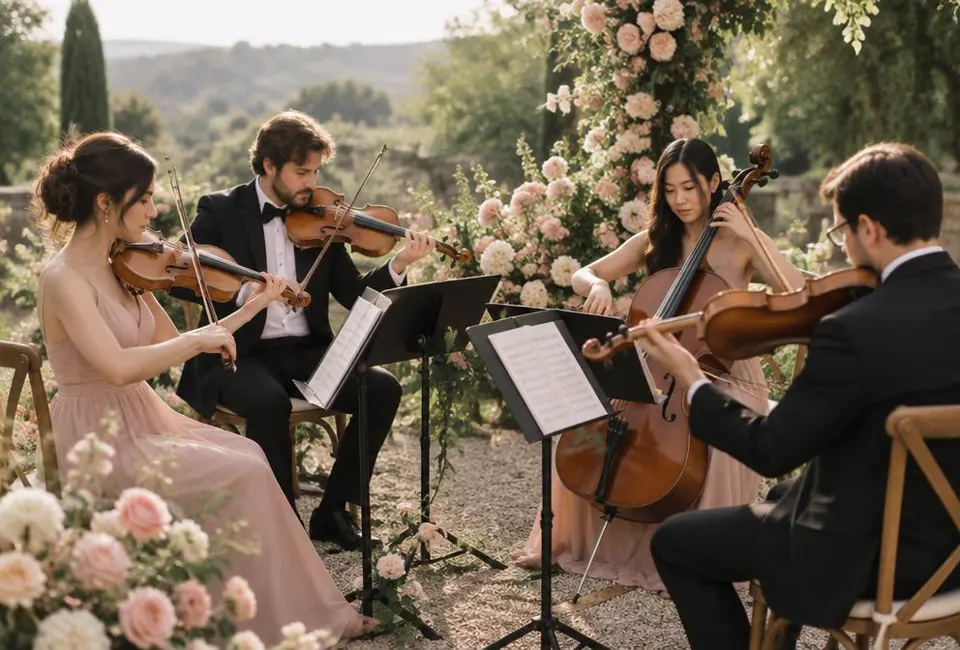
Consider the case of Sarah and Liam, a couple who wanted to honor their traditional backgrounds while showcasing their love for modern nightlife. They utilized a transition strategy to balance these needs. For their ceremony, they selected a string quartet to perform Vivaldi, maintaining a high level of formality. As the evening progressed into the reception, they shifted to a high energy funk and soul band. This contrast worked because they mapped their music to the event timeline, slowly increasing tempo and volume as the day moved from ceremonial reflection to social celebration.
| Event Phase | Target Tempo | Volume Level | Intended Emotion |
|---|---|---|---|
| Processional | 60 to 75 BPM | Low to Moderate | Awe and Reverence |
| Cocktail Hour | 90 to 110 BPM | Background | Social Connection |
| Dinner Service | 70 to 90 BPM | Low | Comfort and Warmth |
| Peak Dancing | 120 to 128 BPM | High | Euphoria and Release |
| Grand Exit | Variable | Moderate | Finality and Joy |
The psychological impact of tempo cannot be overstated. Research suggests that faster beats per minute (BPM) naturally increase heart rates and encourage movement, while slower rhythms promote conversation and digestion. When planning your dinner music, aim for a volume that allows a guest to speak with their neighbor without shouting. Conversely, the dance floor requires a volume that physically moves the air to signal that the time for talking has passed. Mastering these shifts prevents guest fatigue and keeps the momentum building toward a climactic finish.
A common mistake couples make is failing to account for the acoustic properties of their venue. A high ceiling stone cathedral will echo, making complex electronic beats sound muddy, whereas an outdoor garden may swallow sound, requiring more amplification for acoustic instruments. When you define your sonic vision, cross reference your genre choices with the physical space. This ensures your chosen atmosphere is technically achievable. Whether you prefer a jazz lounge vibe or a high octane club setting, clarity in vision allows your vendors to execute your dream with precision.
Steps to Finalize Your Vision
- Audit your personal playlists for recurring genres.
- Identify the 'Peak Energy' moment of the night.
- Assign a specific mood keyword to each hour of the event.
- Determine if live performers or a DJ better fit the aesthetic.
- Discuss volume constraints with the venue manager.
- Create a 'Vibe Board' with 5 to 10 anchor songs.
- Consult your partner on songs that are strictly off limits.
- Test how different tempos feel during a mock dinner at home.
Budgeting for Live Music and Entertainment
Allocating funds for your wedding music planning guide requires a deep dive into global averages and the granular hidden costs that often surprise couples during the final stages of planning. By understanding the fiscal landscape of live performance, you can prioritize high impact entertainment while maintaining a balanced wedding budget.
When assessing the financial landscape, couples must view their music budget within the context of total wedding expenditures. Recent data reveals significant regional variations. In the United Kingdom, averages range from £20,600 according to Bridebook 2024 to £23,000 as reported by Which? 2024. Across the Atlantic, the US average sits at about $33,000 based on The Knot Real Weddings Study 2025, while the Canada average is approximately C$30,000 per RBC findings. In Australia, the Easy Weddings 2025 report cites an average of A$35,315. Typically, entertainment should account for 10 to 15 percent of these total figures depending on the complexity of your vision.
Strategic Allocation and Global Benchmarks
Consider the case of a couple, Sarah and David, who initially budgeted a flat fee for a five piece band without considering logistical overhead. They soon realized that the performance fee was only one part of the equation. To avoid their mistake, use a percentage based framework. Allocate 50 percent to the main performance, 20 percent to technical requirements, 15 percent to travel and lodging, and 15 percent to administrative or miscellaneous fees. This ensures that the primary talent is well compensated while leaving a buffer for the essential infrastructure that allows them to perform effectively at your venue.
| Region | Source and Year | Total Wedding Average | Est. Music Budget (12%) |
|---|---|---|---|
| United States | The Knot 2025 | $33,000 | $3,960 |
| Canada | RBC | C$30,000 | C$3,600 |
| Australia | Easy Weddings 2025 | A$35,315 | A$4,237 |
| United Kingdom | Which? 2024 | £23,000 | £2,760 |
| United Kingdom | Bridebook 2024 | £20,600 | £2,472 |
Calculating the true cost of a performer involves more than the hourly rate. You must utilize the Total Talent Formula: Performance Fee + (Travel Rate x Distance) + (Equipment Rental + Setup) + (Meal Cost x Number of Performers) = Total Investment. If you are hiring a quartet from a city three hours away, your travel rate should account for fuel and time. Furthermore, most professional contracts require a hot meal for every band member. Neglecting to account for these line items can lead to a budget deficit of several hundred dollars or pounds by the time the wedding day arrives.
Mitigating Hidden Technical Costs
Many couples overlook the necessity of equipment rentals when the venue does not provide a sound system or stage. For example, a beachfront ceremony may require battery powered amplifiers and specific microphones to combat wind noise. These technical requirements often carry separate rental fees and delivery charges. When vetting vendors, ask for an all inclusive quote that details sound engineering and lighting. If these are not included, you must source them independently. Failure to plan for these components can result in poor audio quality, rendering even the most expensive live band ineffective during the most critical moments of the night.
Entertainment Budget Verification Steps
- Confirm if the quote includes specialized sound equipment for outdoor settings.
- Calculate total mileage for performers traveling over fifty kilometers.
- Verify the number of vendor meals required in the catering contract.
- Assess the need for additional power generators at remote locations.
- Check for early setup or late teardown surcharges in the contract.
- Allocate a contingency fund of five percent for last minute technical needs.
- Review insurance requirements that may carry a small premium cost.
- Compare the cost of a full band versus a hybrid DJ and musician setup.
- Confirm if lighting for the dance floor is included in the base fee.
Finally, prioritize your spending based on the segments of the day that matter most to your guest experience. If the dance floor is your priority, invest more in a high energy reception band and consider a solo artist or even a curated playlist for the ceremony. Conversely, if you desire a formal atmosphere, a string ensemble might take up a larger portion of the budget. Always communicate your total budget limit to prospective vendors during the first inquiry. Using a script like: Our total entertainment investment is capped at four thousand, does your standard package accommodate this with travel included? will save time for all parties.
The Ceremony: Cues and Technical Precision
The wedding music planning guide hinges on the ceremony, where timing and technical precision transform simple notes into a cohesive emotional narrative.
For couples like Sarah and Liam, the processional requires a clear choreography of sound. The processional should be timed to the exact second that the wedding party enters the aisle. A common mistake is starting the music before the doors open, which dilutes the impact of the entrance. Use a specific cue, such as a hand signal from the coordinator to the musicians, to ensure the melody begins exactly when the first attendant steps forward. The tempo must remain consistent. If the aisle is thirty meters long, the music needs to sustain for roughly two minutes without sounding repetitive or fading out prematurely.
Mastering Transitions: Interludes and the Recessional
The interlude serves as a reflective bridge during the signing of the register or a unity ritual. This is often the most overlooked part of the wedding music planning guide. The volume should drop by roughly thirty percent compared to the processional to allow for quiet conversation or prayer. For the recessional, the shift should be instantaneous. The moment the officiant introduces the couple, the music must burst forth at full volume. This high energy transition signals to the guests that the formal portion has concluded and the celebration has officially begun, preventing an awkward silence during the exit.
Managing guest behavior is essential for a seamless sonic experience. If guests are filming on phones, the shutter clicks and glowing screens can distract from the music. The officiant should deliver a script before the processional begins. For example: Please silence all mobile devices and join us in being fully present. We invite you to tuck away your cameras and phones as the ceremony begins, so that our photographers can capture the moment and you can enjoy the music and the vows without distraction. This ensures the focus remains on the auditory and emotional environment created for the couple.
| Phase | Duration Goal | Volume Level | Transition Style |
|---|---|---|---|
| Prelude | 20 minutes | 40 percent | Continuous loop |
| Processional | 3 to 5 minutes | 80 percent | Definitive start |
| Interlude | 4 to 6 minutes | 30 percent | Soft fade in |
| Recessional | 3 minutes | 100 percent | Immediate burst |
Budgeting for these technical requirements is vital. While the total wedding cost varies globally, such as the UK average of 20,600 pounds according to Bridebook 2024 or 23,000 pounds per Which? 2024, the audio portion remains a critical investment. In Australia, where weddings average 35,315 Australian dollars according to Easy Weddings 2025, or Canada at 30,000 Canadian dollars per RBC, a significant portion goes toward professional sound reinforcement. In the US, where the average reaches 33,000 dollars according to The Knot Real Weddings Study 2025, ensuring that microphones and power sources are reliable is a top priority for outdoor settings.
Outdoor Ceremony Technical Requirements
- Confirm two dedicated 15 amp circuits for audio equipment.
- Secure foam or fur windscreens for all lapel microphones.
- Ensure power cables are industrial grade and taped down.
- Provide a backup battery power station for remote sites.
- Test wireless frequency range to avoid radio interference.
- Verify that all speakers are elevated on stands for projection.
- Arrange for a shaded area for all electronic equipment.
- Check that the officiant has a secondary handheld microphone.
- Coordinate a sound check sixty minutes before guest arrival.
Technical precision also involves accounting for natural acoustics. Wind can distort sound, making professional grade wind protection for microphones non negotiable. If the ceremony is near the ocean, the sound of waves can compete with soft acoustic instruments. In these scenarios, use a direct input for instruments rather than microphones to capture the cleanest signal. By following these practical steps, couples can avoid the common pitfalls of feedback or silent gaps, ensuring their chosen soundtrack perfectly complements the gravity of their vows and the joy of their first walk as a married pair.
Managing the Cocktail Hour Transition
The cocktail hour serves as the emotional bridge between the solemnity of the ceremony and the celebration of the reception. A strategic wedding music planning guide approach ensures this ninety minute window facilitates conversation while elevating the venue energy.
Striking the Balance Between Ambience and Interaction
The primary objective of cocktail hour music is to act as a social lubricant without forcing guests to shout. While the ceremony required focused listening, this phase demands a textural background. For example, Elena and Marcus opted for a jazz trio that played at 65 decibels, roughly the volume of a normal conversation. This allowed guests to mingle freely while feeling the sophisticated pulse of the double bass. Couples should aim for a mix of mid tempo tracks that avoid heavy bass drops or soaring vocal solos, as these frequencies often compete directly with the human voice range.
When deciding between live performers or a curated playlist, consider the physical layout of your venue. Acoustic performers, such as a Spanish guitarist or a cellist playing modern pop covers, offer a visual element that feels premium. However, if your guests are spread across multiple rooms or an outdoor terrace, a high quality sound system with a distributed speaker setup may be more effective. Sarah and David used a curated playlist of bossa nova covers for their garden reception, ensuring the sound was consistent across the entire lawn rather than concentrated in one corner where a band would stand.
| Entertainment Type | Best For | Social Impact | Technical Need |
|---|---|---|---|
| Acoustic Duo | Intimate Courtyards | High visual engagement | Small PA system |
| Solo Saxophonist | Modern Lounges | High energy transition | Backing tracks |
| Curated Playlist | Large Multi Room Venues | Consistent background | House audio system |
| String Quartet | Formal Stately Homes | Classical sophistication | Armless chairs |
A common mistake in the wedding music planning guide process is neglecting the transition between the final ceremony recessional and the first cocktail track. There should be no more than ten seconds of silence. If you are moving guests to a different location, ensure the music is already playing as the first guest arrives. This prevents the awkward feeling of an empty room. Use a fade in technique where the volume starts low and slowly increases as the room fills. This mirrors the natural rise in guest chatter and prevents the music from feeling jarring.
Musical selection during this period should bridge genres to appeal to a multi generational demographic. While the ceremony may have been strictly classical, the cocktail hour can introduce Motown, soft indie folk, or lounge covers of 1980s hits. Avoid the high energy dance tracks reserved for later in the evening. The goal is to build anticipation. If you play the biggest hits too early, you risk exhausting the energy of the crowd before the main reception begins. Save the upbeat anthems for the moment the doors open to the dining room.
Cocktail Hour Music Strategy Checklist
- Confirm power supply access for outdoor acoustic performers.
- Review the playlist for explicit lyrics that may offend older relatives.
- Ensure the transition track starts immediately after the ceremony ends.
- Check that speakers are positioned above head height for better distribution.
- Select a mix of 15 to 20 songs to cover a 90 minute window.
- Designate a person to adjust volume as the crowd size changes.
- Verify that the genre complements the venue aesthetic and appetizers.
- Test the sound levels in the farthest corners of the cocktail area.
Budgeting for these elements remains a key consideration for global couples. With the US average wedding cost at about $33,000 according to The Knot Real Weddings Study 2025, many allocate 5 to 10 percent of their budget to entertainment. In the UK, where costs average £20,600 (Bridebook 2024), couples often choose soloists to save on space. Those in Australia, spending about A$35,315 (Easy Weddings 2025), or Canada, spending about C$30,000 (RBC), should weigh the impact of live music against other floral or decor priorities during this specific hour.
Reception Programming: From Dinner to Dance
The transition from formal dining to the high energy dance floor requires a deliberate wedding music planning guide strategy to maintain momentum without alienating guests. This section outlines how to orchestrate the reception timeline while managing volume and energy levels for a multi-generational crowd.
The grand entrance serves as the sonic boundary between the cocktail hour and the formal reception. To ensure maximum impact, couples should select a high-energy track that begins immediately as the doors open. A common mistake is choosing a song with a long, slow intro that fails to signal the shift in atmosphere. Once the wedding party is seated, the music should transition into a lower-decibel background layer. This allows the master of ceremonies to introduce toasts without competing with the audio. Sound technicians recommend keeping background music at roughly forty percent of the peak dance floor volume to facilitate comfortable conversation during the meal.
Strategic Sequencing for Honor Dances
Honor dances, including the first dance and parent dances, are the emotional anchors of the evening. To keep guests engaged, consider the 'sandwich' method. This involves performing the first dance immediately upon entering the room to capture the full attention of the audience, then saving parent dances for the conclusion of dinner. This second set of formal dances serves as the bridge to opening the floor for everyone. When selecting these tracks, aim for three minutes or less per song. Longer tracks can cause the energy in the room to dip, leading to a loss of focus before the party even begins.
| Phase | Activity | Audio Energy Level | Typical Duration |
|---|---|---|---|
| Grand Entrance | Wedding Party Arrival | High (90-100%) | 5-10 Minutes |
| Dinner Service | Table Conversation | Low (30-40%) | 60-90 Minutes |
| Honor Dances | First and Parent Dances | Medium (60-70%) | 10-15 Minutes |
| Floor Opening | All Guests Invited | Maximum (100%) | 2-3 Hours |
Elena and Marcus implemented a tiered volume strategy to balance the needs of their diverse guest list. They instructed their DJ to focus the sound towards the center of the dance floor using directional speakers. During dinner, the volume was kept low enough that their grandparents could converse without shouting. As the night progressed, the volume increased incrementally. By the time the high-energy sets began, the sound was concentrated on the floor while the peripheral seating areas remained quiet enough for guests who preferred to socialize. This approach ensures that the wedding music planning guide remains inclusive for all age groups and noise sensitivities.
When planning the transition to the dance floor, the first three songs after the honor dances are critical. These should be universal favorites that span generations, such as classic soul or upbeat pop hits from the last three decades. Avoid niche genres or overly aggressive tracks during this initial fifteen-minute window. The goal is to build a critical mass of guests on the floor. Once the crowd is established, the DJ or band can experiment with contemporary hits or specific genres requested by the couple. Monitoring the floor density allows the performer to adjust the tempo and keep the celebration moving forward seamlessly.
Reception Cues for the MC and Audio Team
- Signal the catering staff to pause service two minutes before the first dance begins.
- Ensure the microphone for toasts is wireless and tested for interference near the speakers.
- Coordinate lighting changes to match the tempo shift from dinner to dancing.
- Provide a written phonetic guide for all names to be announced during the grand entrance.
- Establish a clear 'cut-off' signal if a formal dance needs to be shortened mid-song.
- Verify that the volume levels comply with any local noise ordinances or venue decibel limits.
Finalizing the reception flow requires clear communication with all vendors. The music team, the photographer, and the catering lead must be synchronized to ensure that the cake cutting or late-night snacks do not disrupt a peak dancing moment. A common strategy is to schedule these events during a short 'reset' period where the music drops to a medium tempo. By treating the reception as a series of planned waves rather than a flat line of energy, couples can ensure their guests stay until the final song. This structured approach creates a professional and polished experience that reflects the couple's personal style and hospitality.
Vetting Vendors and Contract Essentials
As you navigate the wedding music planning guide, moving from creative vision to formal execution requires a shift into professional scrutiny. Securing your entertainment through rigorous vetting ensures that the atmospheric goals you have set are protected by legal and logistical safeguards.
Interviewing potential vendors requires looking beyond their promotional videos or public playlists. When Sarah and David interviewed a prospective band, they asked for a full video of a recent set rather than a polished highlight reel. This allowed them to see how the lead singer interacted with the crowd during transition periods. You should schedule a video call or in person meeting to gauge their communication style. A vendor who is slow to respond or vague about their setup requirements during the initial inquiry phase will likely present similar challenges during the high pressure environment of your wedding day.
Technical Red Flags and Safety Standards
Reliability is the most critical asset a wedding vendor provides. During the interview, ask specific questions about their failure protocols. For example, inquire about what happens if a mixer fails or if a laptop crashes mid set. A professional DJ should confirm they carry a complete secondary system including cables, controllers, and speakers. Furthermore, verify their liability insurance status immediately. Many international venues require a minimum of one million dollars or local equivalent in public liability coverage before allowing a vendor to plug into their electrical grid. Failing to confirm this can lead to last minute cancellations by the venue manager.
Critical Interview Questions for DJs and Bands
- Do you have a dedicated backup for every piece of essential equipment on site?
- Can you provide a certificate of currency for your public liability insurance?
- What is your exact hourly rate for overtime if the party continues past the contract?
- How do you handle meal breaks and does the music stop during those times?
- Will the specific performers I see in this video be the ones at my event?
- What are your power requirements and do you provide your own sound reinforcement?
The contract must clearly define financial boundaries to prevent budget inflation. In the UK, where the average wedding cost is about 20,600 pounds (Bridebook 2024), unexpected overtime fees can significantly disrupt a couple's remaining funds. Your contract should stipulate the exact start and end times, including load in and sound check periods. Ask for a tiered overtime structure: for example, a fixed fee for each additional 30 minutes requested on the night. This prevents a scenario where a band charges an flat, exorbitant fee for a small amount of extra time. Clear language regarding travel and lodging is also vital for destination events.
Performance riders are often overlooked but contain the granular details that dictate the vendor's comfort and performance quality. Review the technical rider for requirements such as stage dimensions, specific power circuits, or lighting needs that your venue might not be able to accommodate. Similarly, the hospitality rider outlines what you must provide for the performers. If a band requires a three course meal and a private dressing room, these costs must be factored into your total entertainment budget. Negotiate these points before signing to ensure the requirements are realistic for your specific venue layout and catering plan.
Contractual Safeguards and Paperwork
- Confirm the name of the specific lead DJ or band leader assigned to your date.
- Include a clause for equipment failure and the provision of backups.
- Document the exact arrival time for setup and the scheduled sound check.
- Detail the cancellation and postponement policy including non refundable deposits.
- Outline the specific attire expected for all performers and crew.
- Specify the volume limits if the venue has a decibel monitor installed.
- Verify that all travel, parking, and meal expenses are capped or fixed.
- Ensure the contract lists the specific sound and lighting gear included.
- Confirm the process for requesting a replacement if a key performer falls ill.
Finally, ensure the contract addresses the specific flow of your day as outlined in your wedding music planning guide. If you require the DJ to provide a microphone for speeches in a separate room, this must be explicitly stated to avoid extra rental fees on the day. Whether you are planning in Australia with an average cost of A$35,315 (Easy Weddings 2025) or in Canada with an average of C$30,000 (RBC), the goal is the same: eliminate ambiguity. A comprehensive contract acts as a roadmap, ensuring that every technical and professional expectation is met without conflict or surprise expenses.
The Do Not Play List and Guest Requests
The final phase of your wedding music planning guide involves establishing boundaries for the dance floor to ensure the celebration remains aligned with your personal tastes. Managing guest expectations requires a proactive framework that balances hospitality with your unique sonic vision.
Control over the playlist is often a point of tension between couples who want a specific aesthetic and guests who view the reception as a jukebox. To maintain control, establish a clear protocol for your DJ or band leader regarding requests. You might allow requests only if they fit within your pre approved genres, or you could opt for a strict no request policy. For example, Sarah and Mateo decided to allow guests to submit songs during the cocktail hour but gave their DJ final veto power to ensure the high energy house music they preferred for the late night set remained uninterrupted.
The Architecture of the Do Not Play List
Your Do Not Play list is just as critical as your must play list for defining the atmosphere. This list should include specific songs that trigger negative memories, genres that clash with your wedding theme, and overplayed cliches that feel dated. While the global average wedding cost varies, such as C$30,000 in Canada (RBC) or about A$35,315 in Australia (Easy Weddings 2025), your investment in professional entertainment is protected by these boundaries. A well curated list prevents the momentum from stalling due to an ill timed ballad or a controversial novelty track that does not fit your vision.
| Scenario | Guest Request Type | DJ Protocol | Outcome |
|---|---|---|---|
| Inappropriate Genre | Heavy Metal during Dinner | Polite Veto | Atmosphere Maintained |
| The Energy Killer | Slow Ballad on Full Floor | Delay until Dessert | Momentum Preserved |
| Excluded Artist | Song from Do Not Play List | Hard Refusal | Couple Satisfaction |
| Crowd Favorite | High Energy Pop Hit | Immediate Play | Floor Engagement |
Handling the insistent guest requires a script that empowers your vendors without causing social friction. If a guest demands a song that violates your vision, the DJ should be instructed to say, I have a specific program from the couple that I must follow to keep the night on track. This deflects the pressure away from the guest and the vendor. In instances where a guest persists with inappropriate genres, a professional entertainer will use their expertise to steer the conversation toward the approved list, ensuring the couple remains the ultimate authority on the evening soundtrack.
Do Not Play List Essentials
- Identify songs associated with former relationships or past conflicts.
- List novelty line dances that do not fit your formal theme.
- Exclude specific genres like country, EDM, or jazz if they clash.
- Highlight artists whose personal values do not align with yours.
- Ban overplayed radio hits that feel generic or uninspired.
- Note any songs with explicit lyrics if children are present.
- Specify tempo restrictions for transition periods like dinner.
- Communicate the list to your vendor at least one month prior.
Finally, consider the cultural context of your guest list when finalizing your restrictions. While you may personally dislike a certain local tradition, if 40 percent of your guests expect a specific cultural dance, banning it entirely might deflate the room. Balance your personal preferences with the goal of inclusive celebration. By providing a clear framework and trusting your professionals to manage the flow, you ensure your wedding music planning guide culminates in a night that is both authentic to your identity and enjoyable for everyone in attendance.