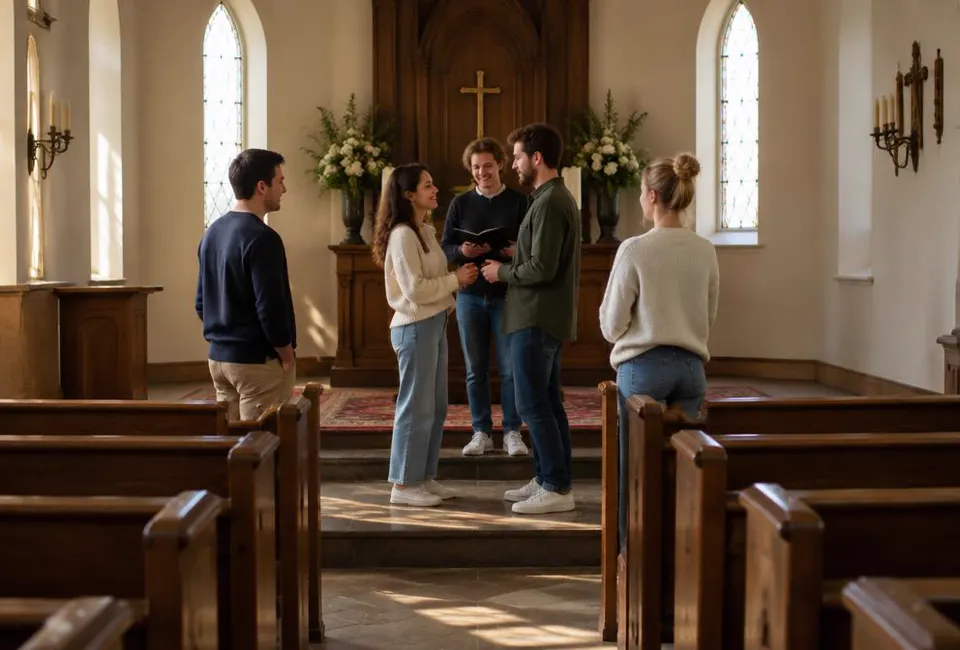
Rehearsal Fundamentals and Optimal Timing
The primary objective of a wedding rehearsal guide is to transform abstract ceremony plans into a physical map of movement. This first section establishes the structural foundation by defining the duration and timing required for a successful practice session.
A wedding rehearsal is not a social hour but a technical run through designed to mitigate anxiety and eliminate logistical confusion. The purpose is to calibrate the speed of the walk, the spacing between bridal party members, and the clarity of the officiant. For example, a couple like Elena and Marcus might feel confident in their plan, but until they physically walk the venue aisle, they cannot account for narrow passages or acoustic dead zones. By treating the rehearsal as a functional briefing, couples ensure that the actual ceremony proceeds with elegance rather than hesitation.
The 60 Minute Efficiency Standard
Couples should aim for 45 to 60 minutes of active practice to achieve mastery without causing participant fatigue. The first 15 minutes typically involve gathering the group and assigning initial standing positions. The subsequent 30 minutes are dedicated to two or three full walk throughs of the processional and recessional. If a rehearsal exceeds 75 minutes, attention spans dwindle and the quality of instruction suffers. Setting a strict one hour limit encourages participants to stay focused on the mechanics of the event rather than drifting into side conversations or checking mobile devices.
| Factor | Day Before (T-24h) | Two Days Before (T-48h) |
|---|---|---|
| Travel Logistics | Ideal for local guests. | Best for long distance travelers. |
| Venue Access | High competition with other events. | Easier to secure evening slots. |
| Stress Levels | High energy, close to event. | Lower pressure, more rest time. |
| Dinner Planning | Seamless transition to dinner. | Allows for separate social events. |
Venue availability often dictates the final schedule. Many popular locations host weddings on Fridays and Saturdays, which might prevent a day before rehearsal for a Sunday wedding. In these cases, a two day lead time is superior to a morning of rehearsal. When Sarah and David found their venue was booked for a corporate event on Friday, they moved their rehearsal to Thursday. This decision allowed their wedding party to relax on Friday evening, which reduced the physical toll of the wedding weekend and ensured everyone was well rested for the main event.
Participant schedules serve as the final filter for choosing a date. If 30 percent or more of the wedding party is flying in from overseas, a rehearsal 24 hours prior is often the only way to ensure full attendance. However, if the wedding party is local, a rehearsal 48 hours prior avoids the rush of final vendor deliveries and allows the couple to focus on their welcome dinner or personal preparations. The goal is to maximize the presence of the officiant and the individuals who have specific cues during the ceremony.
Pre Rehearsal Logistics Checklist
- Confirm the venue access window is at least 90 minutes.
- Send calendar invites to all bridesmaids and groomsmen.
- Print three copies of the ceremony script for the officiant.
- Designate a point person to handle late arrivals.
- Check for local events that might cause traffic delays.
- Verify if the sound system is available for audio testing.
- Ensure all participants have the address of the rehearsal dinner.
- Assign a specific time for the wedding party to arrive at the site.
The Processional: Step by Step Mechanics
The processional sets the tone for the entire ceremony, requiring precise coordination of physical movements and rhythmic timing. This section of our wedding rehearsal guide focuses on the mechanics of the entrance, ensuring every participant understands their spatial requirements.
Mastering the processional requires a balance of natural poise and calculated spacing. During the wedding rehearsal guide walkthrough, participants should practice walking at a pace that feels slightly slower than their usual stride. This measured speed allows guests to appreciate the moment and ensures the photographer has ample opportunity to capture clear shots. Maintain a tall posture by rolling the shoulders back and down, keeping the chin parallel to the floor. If carrying a bouquet, hold it at the level of the belly button to avoid obscuring the dress detail or creating a defensive physical stance.
The most critical technical element is the spacing between pairs or individuals. A practical formula for this is the Five Row Rule: leave four to five pews or rows of chairs between yourself and the person in front of you. This distance prevents the processional from looking like a continuous line and ensures the photographer has a clear line of sight without another person's head blocking the shot. If the venue is an outdoor space without defined rows, count ten slow seconds after the person ahead of you starts their walk before you begin your own movement.
Managing Musical Cues and Staggered Entries
Consider the example of Sarah and Leo. For their ceremony, they chose a specific musical swell for the bridal entrance. During the rehearsal, the wedding party practiced waiting for the officiant to signal that the previous pair had reached the altar before the next group moved. Sarah and Leo used a staggered entry where the wedding party entered to one track, followed by a brief silence and a key change for Sarah. This transition requires the person at the front of the line to hold their position until the music officially shifts, preventing a rushed or cluttered aisle.
| Participant Role | Walking Pace | Spacing Gap | Visual Focus |
|---|---|---|---|
| Officiant | Natural Stride | Lead Position | The Altar |
| Wedding Party | Slow/Measured | 5 Rows/10 Sec | The Guests/Soft Smile |
| Flower Girl/Ring Bearer | Gentle/Directed | 4 Rows | The Floor/End Goal |
| The Bride/Main Entrant | Stately/Slowest | 8 Rows | The Partner |
Consistency is key when executing these mechanics. If one pair walks significantly faster than the others, the visual rhythm of the processional is broken. At the rehearsal, have a coordinator or a trusted friend stand at the back to call out timing cues. If the aisle is particularly short, the spacing might need to be reduced to three rows, but never less. This ensures that the photographer can use a long lens to compress the image without capturing the back of the preceding person. Remember that the walk is not just a transition, but a formal introduction to the ceremony space.
Finally, address the handoff at the end of the aisle. Sarah and Leo practiced the moment where Sarah reached the front, ensuring her father or escort had a clear path to step aside before Leo stepped forward. This avoids a three person traffic jam at the foot of the altar. Each participant should know exactly which side they are turning toward once they reach the front. The rehearsal is the time to iron out these small directional pivots so that on the day, the movements appear fluid, confident, and entirely natural to the watching guests.
Processional Mechanics Checklist
- Confirm the Five Row Rule for spacing between all pairs.
- Practice holding bouquets at navel height for better photos.
- Test the walking speed against the actual ceremony music.
- Identify the specific musical cue for the bride or main entrant.
- Rehearse the pause at the start of the aisle for the photographer.
- Designate a 'spacing captain' to release pairs at the right time.
- Practice the handoff or final transition at the altar base.
- Ensure all participants know their specific exit direction.
- Verify that the pace allows for 10 seconds of clear visibility per pair.
Altar Positioning and Standing Geometry
The visual success of a wedding rehearsal guide depends on precise spatial management at the altar. Mastering standing geometry ensures that the wedding party frames the couple without obscuring the view for guests or professional photographers.
Correct spacing at the altar transforms a cluttered stage into a polished tableau. The primary decision for the couple involves choosing between a straight line or a 'V' formation. In a straight line, the wedding party stands shoulder to shoulder, parallel to the back wall. This works well for minimalist venues but can feel cramped in smaller spaces. The 'V' formation involves angling the attendants slightly toward the guests, with the person closest to the couple standing furthest back. This creates a natural funnel that directs the eyes of the audience toward the center while providing more breathing room for voluminous attire.
The Mechanics of Symmetrical Framing
Symmetry is achieved through consistent arm and hand placement across the entire party. For example, if Sarah and David choose the 'V' formation, all bridesmaids must hold their bouquets at hip level rather than at the waist. Holding flowers too high obscures the neckline of the dress and creates a visual barrier. The officiant should instruct attendants to keep their hands clasped low, allowing the bouquets to rest naturally against the hip bone. This uniform height prevents a staggered, messy appearance in wide angle photography and helps the wedding party feel more anchored during long readings.
Equipment placement, specifically microphone stands, often disrupts the intended geometry. If the officiant requires a stand, it should be placed slightly to one side of their lectern rather than dead center between the couple. The wedding rehearsal guide strategy for mics involves a three point check: height, angle, and cord safety. Ensure the stand does not block the face of the groom or bride from any guest angle. If the couple is using a shared handheld mic, the officiant must direct them to pass it with the hand furthest from the audience to keep their faces visible to the cameras.
Directing Scripts for the Officiant
- Officiant to attendants: Please take a half step back and angle your toes toward the center of the last row of seats to create a clean 'V' shape.
- Officiant to bouquet holders: Imagine there is a horizontal line across your hip bones. Please rest the base of your stems on that line for a uniform look.
- Officiant to the couple: Move three inches closer together so your shoulders overlap slightly. This ensures the mic stand does not appear between you in the photos.
- Officiant to the best man and maid of honor: You are the anchors. Please keep two feet of distance from the couple to allow their attire to spread naturally.
Common mistakes often involve the wedding party bunching too close to the couple out of a desire to hear the vows. This results in a crowded center and empty wings. To fix this, use the 'Two Foot Rule' during the rehearsal. Each attendant should be able to extend their arm fully without touching the person next to them. If the space is tight, the officiant can use a script like: Everyone please find your floor mark, then take one small step toward the side walls to open the frame. This ensures that the couple remains the undisputed focal point of the ceremony.
Altar Positioning Final Inspection
- Confirm the 'V' formation angle is consistent on both sides.
- Verify all bouquet heights are aligned at the hip bone.
- Check that the mic stand does not bisect the couple's faces.
- Ensure attendants have at least twenty four inches of personal space.
- Test that the couple is centered perfectly with the aisle.
- Check that trailing dress fabric or veils have clear floor space.
- Validate that the officiant has enough room to move behind the lectern.
- Confirm no attendant is standing directly in front of a floral pillar.
- Rehearse the handoff of the bouquet to the maid of honor.
Visual balance is not just about the wedding party. The couple must also consider their own standing geometry. For instance, if one partner is significantly taller, the shorter partner should stand slightly forward to balance the frame. During the rehearsal, the officiant should check for 'floating' hands. Attendants who are not holding flowers should choose a standard position, such as clasping hands in front or behind the back, and stick to it for the duration. This level of detail ensures the wedding rehearsal guide translates into a professional and aesthetically pleasing ceremony for everyone involved.
Ceremony Walk Through: Three Essential Rounds
The core of any wedding rehearsal guide involves moving from conceptual planning to physical execution. We break the rehearsal into three distinct phases to ensure every participant understands their movement, their voice, and their timing.
The first phase is the silent walkthrough for positioning. During this stage, the wedding party moves into their final standing spots without music or speaking. The goal is to establish the spatial geometry of the altar and confirm that everyone is spaced evenly. The officiant should stand at the center point, while the couple stands approximately two feet apart to allow room for the bouquet and hand holding. This phase allows the photographer to suggest minor adjustments to the angle of the bridesmaids or the distance between the groomsmen before any words are spoken.
The Verbal Walkthrough for Technical Cues
The second phase is the verbal walkthrough for cues. Here, the officiant reads the first and last lines of each ceremony segment. This helps the couple and the wedding party recognize their triggers for movement. For example, when the officiant says 'you may now exchange rings,' the best man must already be stepping forward. During this phase, David and Amina practice the ring exchange twice. They focus on holding the rings by the sides rather than covering the top. This specific hand placement ensures the videographer captures a clear shot of the jewelry sliding onto the finger without hands blocking the lens.
The final phase is the full speed run. This is a dress rehearsal for the timing and rhythm of the ceremony, minus the full text of the vows. Music should be played at the intended volume to help the bridal party time their walking pace. If the processional music is three minutes long, the party must learn how to pace their steps so the final person reaches the altar as the song concludes. This run through builds muscle memory and reduces the likelihood of nervous rushing on the actual wedding day.
| Phase | Primary Focus | Participants Involved | Duration |
|---|---|---|---|
| Silent Walkthrough | Spacing and Layout | Entire Wedding Party | 15 Minutes |
| Verbal Walkthrough | Transitions and Cues | Couple and Officiant | 20 Minutes |
| Full Speed Run | Timing and Flow | Full Party and Musicians | 15 Minutes |
| Media Check | Visual Angles | Couple and Videographer | 10 Minutes |
Consistency is vital during these three rounds. If a bridesmaid moves to the wrong side during the first round, she must correct it immediately rather than waiting for the final run. The repetition helps eliminate the 'deer in headlights' look often seen in wedding videos. By the time the third round concludes, the group should feel a sense of choreography. This structured approach prevents the rehearsal from devolving into a social gathering, ensuring that the limited time at the venue is used with maximum efficiency for everyone involved.
Three Round Success Metrics
- Confirm every member of the wedding party knows their specific standing spot.
- Verify that the couple can hear the officiant cues over ambient noise.
- Practice the hand off of the bouquet to the maid of honor.
- Ensure the ring bearer knows where to stand after delivering the rings.
- Check that the train of the dress can be easily adjusted by attendants.
- Confirm the videographer has a clear line of sight for the ring exchange.
- Test the microphone levels if using a sound system for the ceremony.
- Rehearse the transition from standing to sitting for guests if applicable.
Officiant Cues and Technical Elements
The fifth stage of your wedding rehearsal guide focuses on the verbal and technical choreography that ensures the ceremony flows without awkward pauses or missed cues. Mastering the transitions between the couple and the officiant prevents the ceremony from feeling disjointed and allows the sound team to capture every syllable of your vows.
The transition from the processional to the formal start of the ceremony often involves the giving away of the partner. If you are including this tradition, the officiant must know exactly when to ask the question to avoid a logjam at the altar. For example, when Sarah reaches the altar with her father, the officiant should wait until they have stopped moving and made eye contact. The script should be clear: Who gives this woman to be married to this man? or Do you give your blessing to this union? The response should be a firm We do or I do. The couple should then practice the physical handoff, where the escort steps back and the couple joins hands, signaling the officiant to begin the welcome.
Transitioning to the vows requires a distinct verbal cue to alert both the couple and the photographer. The officiant should use a specific phrase like I now invite you to share your promises to one another. During the rehearsal, practice the exchange of the microphone or the adjustment of lapel mics. If the officiant is holding the book of vows for Mark and Leo, they must practice the handoff so that hands do not tangle. The couple should stand slightly angled toward the guests rather than facing each other flatly, ensuring the officiant can step back during this intimate moment to remain out of the center of professional photographs.
Technical Timing and the First Kiss
The first kiss is a major technical cue for the musicians and the officiant. To avoid a cluttered photo, the officiant should be instructed to step completely out of the frame before saying the words You may now kiss. This verbal cue serves as the trigger for the sound technician to increase the volume of the recessional music. If the couple, such as Maria and John, plan for a long kiss, the music should swell at the three second mark. During the rehearsal, time this moment repeatedly to ensure the music starts exactly when the couple embraces, creating a seamless emotional peak that carries into the walk back down the aisle.
| Ceremony Phase | Officiant Verbal Cue | Physical Action | Technical Trigger |
|---|---|---|---|
| The Presentation | Who presents this person? | Escort places hand on couple | Mute escort microphone |
| The Vow Exchange | Please join hands. | Officiant steps back | Adjust gain on lapel mics |
| Ring Exchange | With this ring... | Best man produces rings | Tight camera zoom focus |
| The Declaration | I now pronounce you... | Officiant exits the frame | Prepare music track one |
| The First Kiss | You may kiss. | Couple embraces | Music volume to 100 percent |
Placement of ceremonial items is the final technical hurdle. Whether you are using unity candles, a sand pour, or a wine box, these items must be pre positioned on a stable surface. During the rehearsal, the couple should actually walk to the table to check for tripping hazards like rug corners or microphone cables. If a unity candle is used, verify that a lighter or matches are present and that the officiant knows who is responsible for lighting the taper candles initially. Many ceremonies stall because a couple cannot find a flame, so assign one specific person to check this five minutes before the start.
Sound and Ceremony Equipment Checklist
- Test wireless microphone batteries and bring spares to the altar.
- Check that the unity candle or sand vessels are filled and placed.
- Verify the officiant has the final printed script in a binder.
- Ensure the sound technician has the correct recessional track queued.
- Check for wind interference if the ceremony is outdoors.
- Confirm the placement of a small table for the marriage license.
- Test the volume of the officiant against the background music.
- Locate the ring box and verify who is holding it during the start.
- Confirm the path is clear of cables for the couple's movement.
Successful execution relies on the officiant and couple being in total sync. While the global average cost of a wedding varies, such as the UK average of approximately 20,600 pounds according to Bridebook 2024, the value of a well rehearsed ceremony is universal. The technical elements are what prevent a high budget event from feeling unpolished. By practicing the handoffs and verifying the sound equipment, you ensure that the guests are focused on your commitment rather than technical glitches or awkward silences. This rehearsal phase ensures that every spoken word is heard and every symbolic gesture is visible.
The Recessional and Immediate Post Ceremony Flow
The final stage of the wedding rehearsal guide focuses on the recessional, ensuring the couple exits with high energy while maintaining an orderly flow for the wedding party. This transition requires specific choreography to prevent a bottleneck at the ceremony exit and move participants to the next location smoothly.
Mastering the Order of Departure
The recessional begins the moment the officiant introduces the couple. Example couple Sarah and David should wait for the peak of their exit music before turning to face their guests. They lead the departure at a brisk, joyful pace. Following them, the wedding party exits in pairs, typically in the reverse order of their arrival. If the bridesmaids and groomsmen entered separately, they should pair up at the altar to exit together. This creates a symmetrical visual and keeps the line moving. Finally, the parents and immediate family members are escorted out by the ushers or follow independently, signaling the official end of the formal proceedings.
Timing is critical during the exit to avoid a gap or a crowded aisle. Each pair should wait until the couple ahead of them is roughly halfway down the aisle before starting their walk. For example, when Marcus and Leo reach the fifth row of guests, the first bridesmaid and groomsman should begin their movement. This spacing allows photographers to capture clear shots of every participant without other people cluttering the background. If the wedding involves children, such as flower girls or ring bearers, they should walk immediately after the couple or be guided out by a parent to ensure they do not wander off course.
| Participant | Visual Cue to Start | Pace Level | Post Exit Target |
|---|---|---|---|
| The Couple | Music Peak | High/Brisk | Private Room |
| Wedding Party | Lead Couple at Row 5 | Moderate | Secondary Holding Area |
| Flower Girl/Page | Directly After Couple | Steady | Parental Care |
| Parents/VIPs | Final Party Pair Exits | Slow/Dignified | Cocktail Hour Entry |
A common mistake in the wedding rehearsal guide is forgetting the immediate post ceremony flow. Once the wedding party exits the ceremony space, they must continue moving at least twenty meters away from the doors. If Sarah and David stop just outside the entrance to hug, the entire wedding party will stall in the aisle, creating a logistical logjam. Rehearse a specific landing zone. This zone should be far enough to remain out of sight of the guests still seated but close enough for the coordinator to gather everyone for formal portraits. Designated ushers should then begin directing guests toward the reception or cocktail lounge to clear the ceremony area.
The energy of the recessional sets the tone for the celebration. While the processional is somber and slow, the exit should be celebratory. Encourage the wedding party to smile and interact briefly with guests as they pass. However, they should not stop to chat. If the venue has narrow corridors, the rehearsal must account for where the party will stand while the guests filter out. Using a hidden side room or a designated outdoor garden space prevents the party from being trapped by well-wishers before the formal photo session begins. This discipline ensures the timeline stays on track and the transition to the party remains seamless.
Recessional Logistics Checklist
- Confirm the specific music cue for the couple to turn and start walking.
- Practice the pairing of bridesmaids and groomsmen for the exit.
- Identify the specific row number that triggers the next pair to walk.
- Designate a primary holding area at least 20 meters from the exit door.
- Brief parents on their specific cue to stand and exit after the party.
- Instruct the wedding party to keep walking until they reach the holding zone.
- Verify that ushers know how to direct guests to the next location.
- Ensure the couple has a clear path to a private space for a few moments alone.
- Check that no décor or floral pillars obstruct the wider exit path.
Common Mistakes and Rehearsal Etiquette
The final phase of your wedding rehearsal guide focuses on maintaining order and professional decorum to ensure the practice remains efficient and productive. Mastering the social dynamics of the group is just as vital as the physical choreography for a stress-free event.
Efficiency is the cornerstone of a successful walkthrough, yet many couples fall into the trap of a delayed start. When a wedding party consists of ten or more people, a ten minute delay for one person becomes a collective loss of nearly two hours of productivity. In the context of global averages where Canadian couples spend around C$30,000 according to RBC, every minute of venue time represents a significant investment. Arrive fifteen minutes early and set a hard start time. This punctuality establishes a professional tone and ensures that the rehearsal does not bleed into the dinner reservation.
Establishing a Single Point of Command
A common mistake involves allowing too many voices to lead the session. When parents, bridesmaids, and groomsmen all offer conflicting opinions on pacing or posture, the group loses focus. Appoint one specific rehearsal director. This is typically the wedding planner or the officiant. If Sarah and David are self coordinating, they should designate a trusted, assertive friend who is not in the wedding party to hold the clipboard. This director makes final calls on spacing and timing, preventing the session from devolving into a social hour or a committee meeting.
Managing vocal family members requires a balance of kindness and firm boundaries. If a relative continuously interrupts with suggestions, the rehearsal director should use a script such as: We appreciate that idea, but we are following a specific timeline to ensure everyone gets to dinner on time. Please hold all feedback until the end. By externalizing the authority to the director, the couple avoids personal conflict. This keeps the atmosphere light while ensuring the logistics remain the priority for the duration of the practice.
| Attendee Category | Requirement | Primary Responsibility |
|---|---|---|
| Wedding Party | Mandatory | Learning physical marks and pacing. |
| Parents and Guardians | Mandatory | Practicing seating and processional timing. |
| Flower Girls and Ring Bearers | Recommended | Acclimatizing to the aisle length and crowd. |
| Readers and Musicians | Mandatory | Testing sound levels and cue transitions. |
| Plus Ones and Siblings | Optional | Observing quietly from the back rows. |
Finally, the guest list for the rehearsal should be strictly limited to those with an active role in the ceremony. Inviting extended family or out of town guests who are not involved in the processional creates unnecessary noise and distraction. Focus on the core group to ensure the mechanics are flawless. Once the final recessional is practiced and the director gives the all clear, the group can transition into the social atmosphere of the rehearsal dinner. This clear separation between work and celebration is the hallmark of a well managed wedding weekend.
Final Rehearsal Etiquette Checklist
- Silence all mobile phones before the first walkthrough begins.
- Confirm the rehearsal director has the final version of the script.
- Provide a printed processional order to all participants.
- Walk at a natural pace rather than rushing through the motions.
- Practice the handoff of the rings to ensure the best camera angles.
- Designate a specific spot for wedding party members to place personal items.
- Confirm the exact start time for the following day with every participant.
- Brief the ushers on how to handle late arriving guests.
- Perform a final check of the sound system and microphone batteries.